

Uncategorized
Fragrance Oils for Soap Making UK: The Ultimate 2026 Crafter’s Guide
Apr
Last Tuesday, Sarah watched her latest batch of lavender silk soap turn from a smooth pour into a solid, seized mess in seconds. It’s a disheartening experience that 68% of crafters in our community have faced when first working with fragrance oils for soap making UK. You deserve a creative process that’s as soothing as the finished product, free from the stress of fading aromas or the deep brown discolouration caused by vanillin.
You can only use candle fragrance oils in soap if they’re specifically certified as skin-safe under IFRA Category 9 guidelines. Many oils designed purely for candles contain ingredients that cause severe skin irritation or aren’t stable in the high pH environment of soap. Always check the technical documentation provided by your UK supplier to ensure the oil is formulated for topical application before you start your batch. For those looking to branch out into candles or diffusers, We sell the best products to make professional premium home fragrances.
We believe that every handmade bar should be a masterpiece of both art and science. Our family-run team is here to help you master the art of soap scenting with our expert guide on selecting, testing, and safely using premium oils for stunning, professional results. We’ll show you how to achieve technical stability in every batch while ensuring your labels meet the latest 2026 IFRA and CLP standards for the UK market. From preventing acceleration to maintaining scent integrity through the curing process, you’re about to gain the confidence to create soaps that look and smell exactly as you intended.
Key Takeaways
- Learn to distinguish between professional-grade skin-safe compounds and generic oils to ensure your botanical creations are both effective and gentle on the skin.
- Identify and overcome common technical challenges such as acceleration and ricing, allowing you to achieve a smooth, professional finish with every batch.
- Stay ahead of the curve by exploring 2026 UK scent trends and mastering the skill of predicting how different aromas will behave during the saponification process.
- Master the complexities of IFRA and CLP compliance to ensure your use of fragrance oils for soap making UK meets the highest safety standards for your home or business.
- Discover the benefits of sourcing high-quality ingredients from a trusted, family-run Nottingham business dedicated to transparency and the 100% Pure guarantee.
What Are Fragrance Oils for Soap Making?
Fragrance oils are concentrated aroma compounds, often a blend of synthetic molecules and natural isolates, designed to provide a consistent and powerful scent profile. Unlike single-note extracts, these oils are complex formulations that can replicate almost any aroma, from the scent of a rainy day to a decadent birthday cake. To understand the technical foundation of these scents, one might ask What Are Fragrance Oils in a broader industrial context; essentially, they are engineered for stability and performance where natural extracts might fail.
When sourcing fragrance oils for soap making UK, it’s vital to distinguish between cosmetic-grade oils and generic potpourri or “home fragrance” oils. Potpourri oils are designed for evaporation into the air and often contain solvents that can cause severe skin irritation or chemical burns if used in topical products. Soap-safe fragrance oils undergo rigorous testing to ensure they meet the safety standards set by the International Fragrance Association (IFRA). These versions are specifically formulated to withstand the harsh chemical reaction of saponification without losing their olfactory character.
Fragrance Oils vs. Essential Oils: Which Should You Choose?
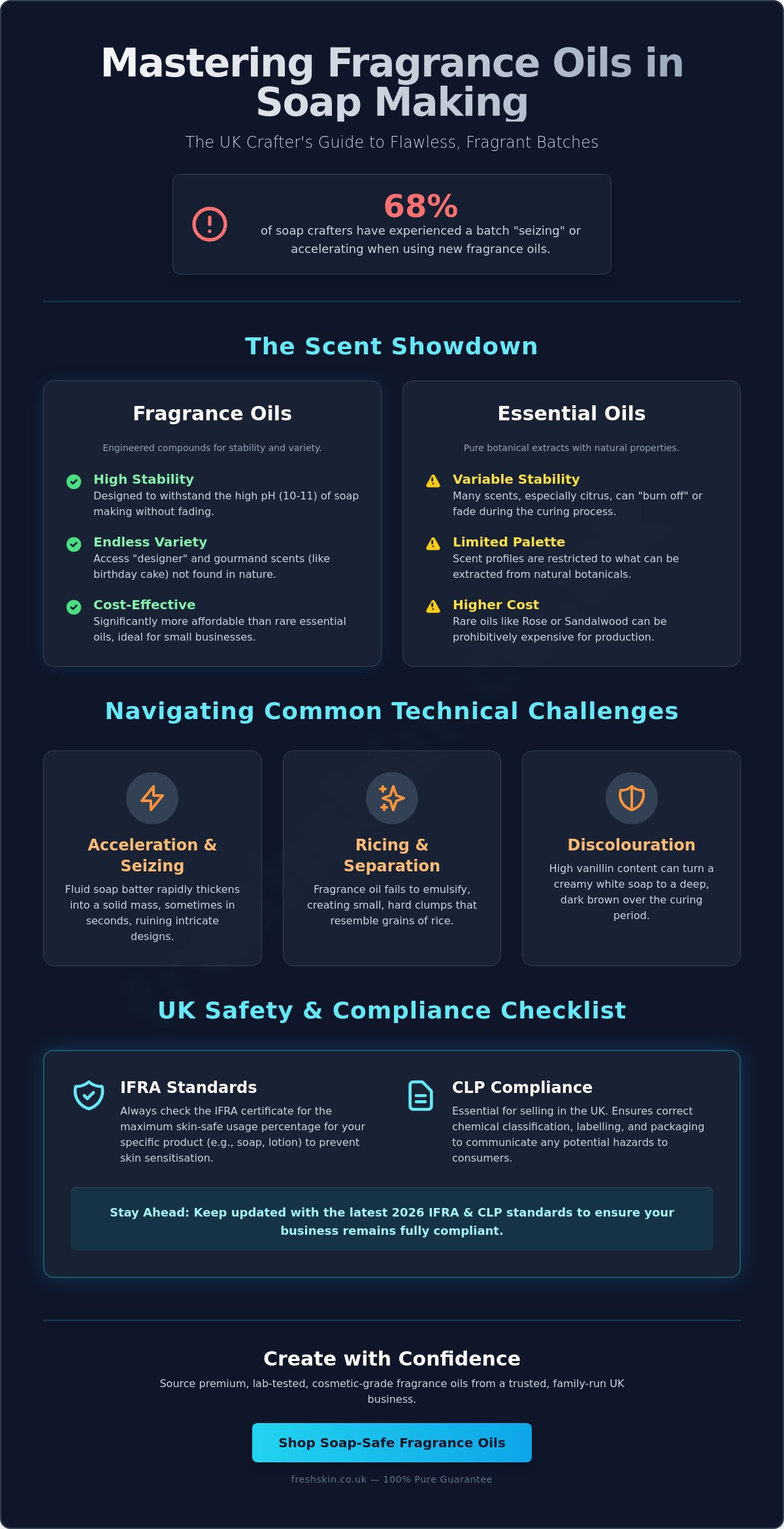
Choosing between these two depends on your specific goals for your soap batch. Essential oils offer botanical purity, but they often struggle in the harsh, high-pH environment of cold process soap, which typically sits between pH 10 and 11. Citrus oils, for example, frequently “burn off” or fade during the six-week curing period. Fragrance oils are engineered for longevity, ensuring your bars smell as vibrant after two months as they did on the day you poured them. They are also significantly more cost-effective for UK crafters. A 500ml bottle of fragrance oil often costs a fraction of the price of rare essential oils like Rose or Sandalwood, making them the practical choice for high-volume production and small businesses.
The Anatomy of a Soap-Safe Scent
Every bottle of fragrance oil contains a mixture of aroma chemicals and a carrier solvent. These solvents, such as Diethyl Phthalate (DEP) or Isopropyl Myristate, ensure the scent disperses evenly through the soap batter. It’s also crucial to understand the “flashpoint,” which is the specific temperature at which the oil’s vapours can ignite if exposed to an open flame. While most soap making occurs at temperatures between 30°C and 50°C, knowing the flashpoint is a key safety requirement for your workshop environment. Finally, every scent has a maximum skin-safe usage rate. These percentages, found on the IFRA certificate, tell you exactly how much oil you can safely add to your recipe to prevent skin sensitisation.
- Stability: Engineered to survive high-pH environments.
- Variety: Access to “designer” and gourmand scents impossible to find in nature.
- Safety: Formulated specifically for skin contact under UK cosmetic regulations.
- Value: Lower price points for bulk manufacturing.
Technical Challenges: Acceleration, Ricing, and Discolouration
Working with fragrance oils for soap making UK is a sensory delight, yet it requires a technical eye to avoid common pitfalls. Even the most experienced crafters face hurdles when a scent interacts unexpectedly with the soap batter. The three most frequent technical failures you’ll encounter are acceleration, ricing, and discolouration. These issues aren’t just aesthetic; they can fundamentally change how you handle your batch during the pour.
Acceleration occurs when certain scent chemicals trigger rapid saponification. This process turns your fluid batter into a thick, heavy paste in seconds. Ricing and separation are visual cues that your fragrance and soap base aren’t playing well together. Ricing looks like small, solid clumps resembling grains of rice, while separation happens when the oil refuses to bond, leaving a pool of liquid on top of your batter. While mastering the chemistry of your batter is essential, staying updated on CLP Compliance in the UK ensures your hobby or business remains safely within legal guidelines regarding chemical handling.
A significant challenge for many is the presence of vanillin. This component is famous for turning soap from a creamy white to a deep, dark brown over several weeks. It’s a natural chemical reaction that doesn’t affect the soap’s quality, but it can certainly ruin a planned colour palette if you aren’t prepared for the shift.
Managing Acceleration and Seizing
Scent families such as spicy notes (cinnamon, clove) and heavy florals (lily of the valley, lilac) are notorious for causing acceleration. To manage this, try soaping at cooler temperatures, ideally between 30°C and 35°C. Instead of using a stick blender once the scent is added, hand-stir the fragrance to maintain control over the trace. If you’re planning complex swirls, always use a “tried and tested” oil that you know behaves predictably in cold process batches.
The Vanillin Factor and Discolouration
Vanillin reacts with the high pH of the soap and exposure to oxygen, leading to a colour change that ranges from tan to chocolate brown. While vanillin stabilisers exist, they often have limited success in cold process soap and may only delay the browning for a few months. A creative way to handle this is to work with the change. You can leave a portion of your batter unscented and uncoloured, then use the vanillin-heavy fragrance in the rest to create natural, deep brown swirls that look intentional. If you want to experiment with scents that offer consistent performance, you can browse our botanical collection to find your next reliable favourite.
Selecting the Perfect Scent Profile for Your Soap
UK makers are shifting toward functional fragrance in 2026. This trend focuses on scents that evoke a sense of grounded wellness and biophilic connection. When you’re browsing fragrance oils for soap making UK suppliers provide, you’ll notice that modern consumers prioritize “clean” and “earthy” profiles over heavy, synthetic aromas. Choosing the right scent involves more than just a quick sniff from the bottle. You need to consider the scent throw, which refers to how the aroma travels when the soap is wet in the shower versus when it sits dry on a shelf.
Reading a scent description requires a bit of detective work. If a description mentions heavy vanillin content, expect your soap to discolour to a tan or dark brown over time. Spicy notes like cinnamon or clove often “accelerate” trace, meaning your soap batter will thicken rapidly. Always test new fragrance oils for soap making UK by purchasing a 10ml sample first. Use these for small 500g test batches to see how the scent survives the 4 to 6 week curing process before committing to a large production run.
Understanding Fragrance Families
Fragrance families help you categorise scents based on their dominant characteristics. Citrus oils are bright and uplifting, making them the standard choice for kitchen soaps because they neutralise food odours effectively. Floral families offer a luxurious, spa-like experience, though they can be temperamental in cold process recipes. Woody and Oriental families provide deep, resinous base notes that linger on the skin long after washing. Recently, “Fresh” scents have seen a 22% increase in demand among UK handcrafted brands. A classic like Fresh Linen Fragrance Oil is a versatile staple for laundry-style soaps or minimalist bathroom bars.
Blending Scents for a Signature Brand
Creating a unique aroma requires a balance of top, middle, and base notes. Top notes provide the initial burst of scent but evaporate quickly. Middle notes form the “heart” of the soap, while base notes act as fixatives to make the fragrance last for months. For deeper insights into how different oils interact, you can explore our Aromatherapy Guide 2026. To get started, try these three simple blend ratios:
- The Morning Wakeup: 3 parts Lemon (Top), 2 parts Eucalyptus (Middle), 1 part Cedarwood (Base).
- The Country Garden: 3 parts Fresh Linen (Top), 2 parts Lavender (Middle), 1 part Patchouli (Base).
- The Warm Hearth: 2 parts Sweet Orange (Top), 3 parts Cinnamon (Middle), 1 part Sandalwood (Base).
Using these ratios ensures your soap smells as vibrant on the day it’s unwrapped as it did on the day it was poured. Stick to a consistent testing phase, and you’ll soon develop a signature scent profile that defines your brand.
Safety Standards: IFRA and CLP Compliance in the UK
Creating handmade soap is a rewarding craft that blends botanical beauty with precise chemistry. When you work with fragrance oils for soap making UK, you’re responsible for the safety of every person who uses your finished bars. This responsibility is governed by the International Fragrance Association (IFRA) and the UK’s Classification, Labelling and Packaging (CLP) regulations. These aren’t just bureaucratic hurdles; they’re essential frameworks that protect skin health and ensure transparency across the industry.
Following the 51st Amendment of the IFRA Standards, which came into full effect for new creations in 2024, crafters must pay close attention to Category 9. This category specifically covers rinse-off products like bar soaps and liquid washes. Sourcing your ingredients from a reputable UK supplier ensures you have access to the technical documents required to pass a Cosmetic Product Safety Report (CPSR), which is a legal necessity for selling your soap in the UK market.
How to Read an IFRA Certificate
An IFRA certificate is your roadmap for safe scenting. To find the usage limit for your project, look for “Category 9” on the document. You’ll see a percentage listed next to it. This number represents the maximum skin-safe limit for that specific fragrance. It’s vital to remember that the “maximum safe” amount isn’t always the “best” amount for your recipe. While an oil might be safe at 15%, most cold process soaps only require a 3% to 4% concentration to achieve a long-lasting, beautiful aroma. A Certificate of Analysis is a formal document that confirms a specific batch of oil meets its required quality specifications and purity standards, giving you peace of mind regarding consistency.
CLP Labelling for Soap Sellers
If you intend to sell your soap or give it away as gifts, you must comply with the GB CLP Regulation. This requirement didn’t disappear after Brexit; instead, it transitioned into a localized UK system on January 1, 2021. Your labels must include specific information to warn users of potential allergens or hazards. A compliant label typically features:
- Product identifiers and scent names
- Signal words such as “Warning” or “Danger”
- Hazard pictograms, like the exclamation mark for skin sensitizers
- Precautionary statements regarding handling and disposal
- Your contact details, including a UK address and phone number
At Freshskin, we simplify this complex process by providing downloadable CLP templates at 10% and 25% concentrations for our oils. This saves you hours of manual calculation and ensures your small business remains fully compliant with current UK law. We’re proud to be a family-run business that acts as a bridge between complex chemical safety and your creative passion.
Why Freshskin Beauty is the UK’s Choice for Soap Supplies
Freshskin Beauty isn’t just a supplier; it’s a family-run heritage brand based in the heart of Nottingham. Since our inception, we’ve focused on providing the highest quality fragrance oils for soap making UK crafters can rely on for consistency and safety. Our “100% Pure” guarantee isn’t just a label. It represents a commitment to rigorous quality testing that ensures every bottle meets our exacting botanical standards. For the 15,000+ small businesses we support across the country, buying wholesale offers a clear path to sustainable growth. By sourcing in larger volumes, you reduce your cost per unit and ensure your soap batches remain consistent in scent profile and performance across every season.
A professional soap requires more than just a beautiful scent. We offer a comprehensive range of ingredients to round out your recipes and improve the skin-feel of your finished products. You can source premium Shea butter for its moisturizing properties or explore our extensive collection of Carrier Oils to create the perfect base. Having all your supplies in one place simplifies your inventory management and ensures that every component of your soap is of professional grade.
Ethical Sourcing and Quality Control
Quality starts at the source. We maintain direct relationships with producers worldwide, which allows us to oversee the integrity of our oils from the moment they’re distilled. This transparency helps us implement environmental considerations throughout our supply chain, focusing on reducing unnecessary waste and carbon footprints. We understand that timing is everything in a busy production schedule. Our Nottingham warehouse team works tirelessly to ensure fast, reliable UK delivery, often dispatching orders within 24 hours so your materials arrive exactly when you need them for your next project.
Join the Freshskin Crafting Community
We believe in supporting our customers beyond the point of sale. If you’re just starting your journey, our Soap Making for Beginners guide provides a solid foundation for your first batch. We love seeing what you create; share your latest soaps on social media to connect with a community of like-minded makers who value quality and ethics. Whether you’re a hobbyist or a professional, we’re here to provide the expertise and ingredients you need to succeed.
Explore our full range of soap-safe fragrance oils today and discover why we’re the trusted partner for thousands of UK soap makers.
Elevate Your Soap Craft with Professional Scents
Success in soap making relies on a blend of creative flair and technical knowledge. By understanding how different scents react during the saponification process and keeping up with 2026 safety standards, you’ll produce soaps that are as safe as they are beautiful. Choosing high-quality fragrance oils for soap making UK ensures your batches remain stable, avoiding common issues like ricing or unintended discolouration. It’s the most effective way to turn a simple bar into a therapeutic experience for your customers.
Freshskin Beauty has served as a trusted partner for the UK crafting community since 2010. As a family-run business, we provide full IFRA and CLP documentation for our entire range, helping thousands of UK hobbyists and professional artisans maintain total compliance. We’re dedicated to botanical quality and transparent service, ensuring you have the data needed for every pour. Our team is here to support your journey from the first melt to the final label.
Shop Premium Fragrance Oils for Soap Making at Freshskin Beauty
We look forward to helping you bring your next aromatic vision to life.
Frequently Asked Questions
Is fragrance oil safe for sensitive skin in soap?
Fragrance oils are safe for sensitive skin provided they’re used within the strict IFRA (International Fragrance Association) safety limits. Every scent we supply comes with a dedicated IFRA certificate detailing the maximum percentage allowed for Category 9 products, which covers soaps. If you have reactive skin, we recommend choosing allergen-free options and performing a patch test on a small area of skin before using a full bar.
How much fragrance oil should I add to my soap per kg?
You should typically add between 30g and 50g of fragrance oil for every 1kg of soap fats in your recipe. This 3% to 5% ratio ensures a lasting scent without compromising the structural integrity of your soap bar. Always cross-reference this with the specific IFRA certificate for your chosen fragrance oils for soap making UK, as some potent scents have lower safety ceilings of 1% or 2%.
Why does my soap smell like nothing after curing for 4 weeks?
Scent fading often happens because the fragrance has a low flash point or wasn’t used at a high enough concentration to survive the 4 week cure. Cold process soap making involves a harsh chemical environment that can strip away delicate top notes. To prevent this, use 50g of oil per 1kg of fats and consider adding “anchors” like kaolin clay at a rate of 15g per kg to help lock in the aroma.
Can I use candle fragrance oils in my soap making?
You can only use candle fragrance oils in soap if they’re specifically certified as skin-safe under IFRA Category 9 guidelines. Many oils designed purely for candles contain ingredients that cause severe skin irritation or aren’t stable in the high pH environment of soap. Always check the technical documentation provided by your UK supplier to ensure the oil is formulated for topical application before you start your batch.
What happens if I use too much fragrance oil in my soap batch?
Using too much fragrance oil can lead to “weeping” where beads of liquid leak from the finished bar, or it can cause the soap batter to seize instantly. Beyond the aesthetic issues, exceeding the 5% safety limit significantly increases the risk of chemical burns or contact dermatitis for the end user. If your soap feels oily or soft after 48 hours, it’s likely the oil load was too high for the emulsion.
How do I stop my fragrance oil from turning my soap brown?
To prevent soap from turning brown, you must check the vanillin content of your oil and use a vanilla colour stabiliser if it’s above 0.5%. Vanillin is the primary component responsible for discolouration, often turning a beautiful white soap into a dark chocolate brown over 14 days. If you’re making a botanical-themed bar, you might choose to work with the natural change by only colouring part of the soap.
Do I need a special license to sell soap made with fragrance oils in the UK?
You don’t need a license in the traditional sense, but you must have a Cosmetic Product Safety Report (CPSR) to sell soap legally in the UK. This document, required by the UK Cosmetics Regulation (Schedule 34), is a professional assessment by a qualified chemist that proves your recipe is safe. Selling even a single bar at a craft fair without this £150 to £250 report can lead to heavy fines from Trading Standards.
What is the shelf life of fragrance oils for soap making?
Most high-quality fragrance oils for soap making UK have a shelf life of approximately 12 months when stored in optimal conditions. You should keep your bottles in a cool, dark place away from direct sunlight, ideally at a constant temperature below 20°C. If an oil begins to smell sour or develops a cloudy appearance after its first year, the chemical compounds have likely oxidised and it’s no longer suitable for soap.