
Uncategorized
How to Get a Strong Scent Throw from Soy Candles: The Ultimate Guide
Jun
Adding extra fragrance oil is often the quickest way to ensure your candle has no scent at all. It is incredibly frustrating to spend your budget on premium botanical oils only to end up with a finished product that barely whispers its aroma. You might feel that soy wax is working against you, naturally trapping the scent instead of releasing it into your home. We understand that you want your space to feel like a therapeutic sanctuary, filled with the calming notes of pure lavender or refreshing rosemary. This guide will show you how to get a strong scent throw from soy candles by mastering the precise science of wax-oil bonding, temperature control, and patient curing. We will walk through the essential technical details of flash points and pour temperatures to ensure your next batch delivers the professional, room-filling results you expect. You will also learn how to stay compliant with the latest safety standards, ensuring your creations are as safe as they are beautiful.
Key Takeaways
- Learn why heating your soy wax flakes to exactly 85°C creates the perfect molecular bond for fragrance oils.
- Discover how to get a strong scent throw from soy candles by selecting the correct wick size to achieve a full melt pool within four hours.
- Master the precision of weighing ingredients in grams rather than volume to maintain a safe and effective fragrance load.
- Understand the essential curing process that allows soy wax to lock in botanical scents for a superior hot throw.
- Identify common troubleshooting issues, such as room dimensions and scent compatibility, that may be dampening your candle’s performance.
Understanding Scent Throw: Cold vs. Hot Performance
Scent throw is the hallmark of a high-quality candle, yet it remains one of the most common hurdles for makers. To master how to get a strong scent throw from soy candles, you must first distinguish between cold and hot performance. Cold throw refers to the intensity of the fragrance when the candle is unlit at room temperature. It is the sensory invitation that greets a customer when they first open a jar. Hot throw, however, is the fragrance emitted while the candle is burning and the wax is heated. While a potent cold throw is vital for initial appeal, the hot throw is what creates the therapeutic atmosphere your customers crave.
Achieving a room-filling hot throw is naturally more complex with soy wax than with paraffin. Soy candles are celebrated for their clean, sustainable burn, but the dense molecular structure of vegetable-based wax can make it difficult for fragrance to escape. The secret lies in the melt pool. As the flame heats the wax, it creates a liquid layer across the surface. This pool acts as a vehicle, carrying scent molecules into the air through evaporation. If the melt pool is too shallow or doesn’t reach the edges of the container, the fragrance remains trapped in the solid wax below.
The Science of Soy Wax Crystallisation
Soy wax is a natural product that undergoes a specific crystallisation process as it solidifies. If the wax is cooled too quickly or the fragrance is added at the wrong temperature, the crystalline structure can effectively lock fragrance molecules inside. This prevents them from migrating to the surface during the burn. Using professional-grade soy wax flakes provides a more stable foundation for your creations. These flakes are designed to be handled with thermal precision, allowing for a more uniform bond between the wax and your chosen botanical oils. When handled correctly, the wax structure remains flexible enough to release those aromatic compounds once heat is applied.
Why ‘More Oil’ Isn’t Always the Answer
When a candle lacks punch, the instinctive reaction is often to add more fragrance. This approach usually leads to diminishing returns. Every wax has a saturation point, typically between 6% and 10% fragrance load. Exceeding this limit causes several technical failures:
- Sweating: Excess oil leaches out of the wax, forming dangerous puddles on the surface.
- Sooting: Unbound oil burns off as heavy black smoke rather than a clean scent.
- Wick Clogging: Heavy oil loads can saturate the wick, resulting in a weak, struggling flame that cannot maintain a proper melt pool.
Instead of overloading the wax, focus on finding the sweet spot where the oil and wax bond perfectly. This balance ensures a clean burn and a sophisticated fragrance release that feels effortless rather than overwhelming.
Mastering Temperature: The Key to Molecular Bonding
Temperature control is the most influential factor in your candle-making process. It determines whether your fragrance oil successfully bonds with the wax or simply sits as a separate layer. To understand how to get a strong scent throw from soy candles, you must view the wax as a living structure that opens and closes based on thermal energy. When soy wax reaches its specific binding window, typically 85°C, the molecular chains expand. This expansion creates the necessary space for fragrance molecules to interlock with the wax. If you add your oil when the wax is too cool, the molecules cannot bond effectively, leading to “oil pockets” that result in a weak, inconsistent scent when the candle is lit.
Many makers worry about flash points, fearing that adding oil at 85°C will “burn off” the scent. In reality, a flash point is the temperature at which a liquid’s vapours can ignite if exposed to an open flame, not the temperature at which it evaporates. High-quality vegetable waxes, such as Cargill NatureWax, are specifically engineered to handle these temperatures to ensure a standout scent throw and a clean, reliable burn. Once the oil is added, you must stir the mixture gently but thoroughly for at least two minutes. This ensures full emulsification, preventing the oil from settling at the bottom of your pouring jug.
Step-by-Step Temperature Control
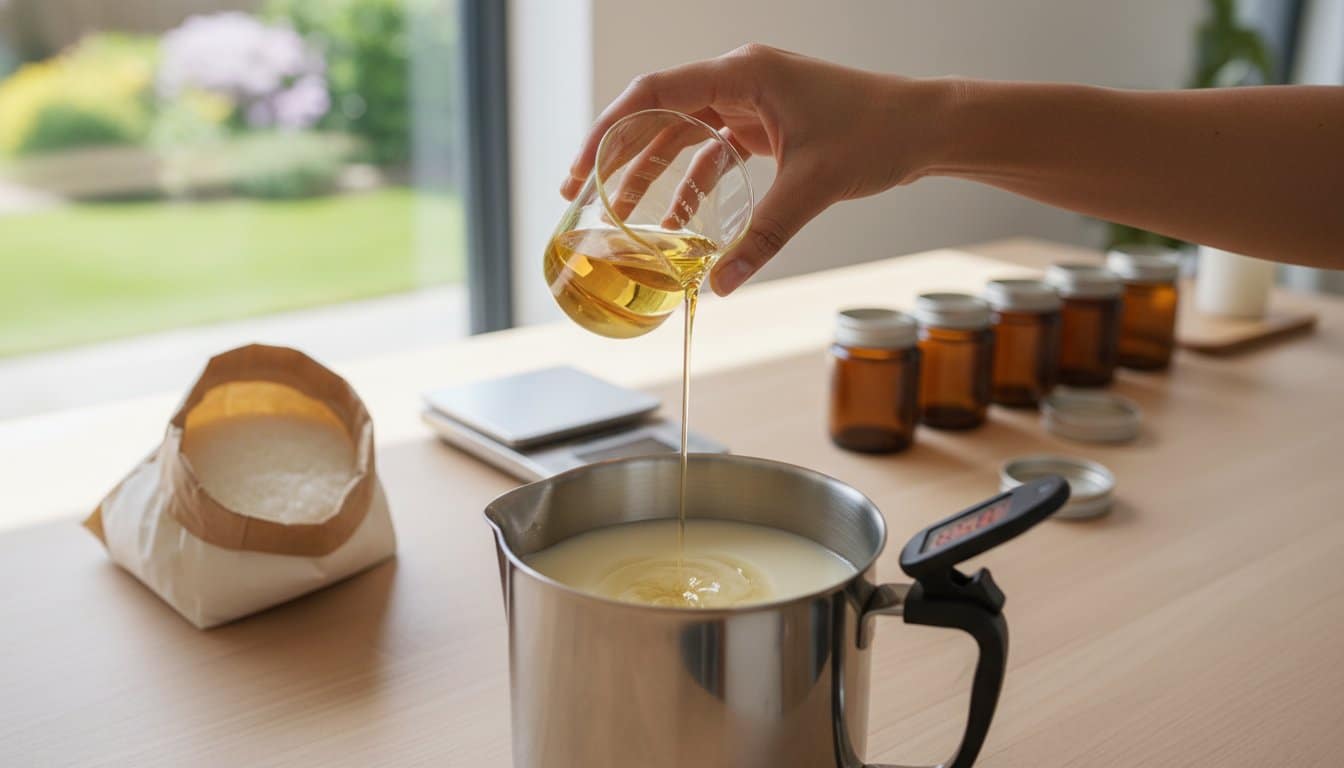
Start by heating your soy wax flakes in a double boiler until they reach exactly 85°C. Use a digital thermometer for precision, as even a few degrees can alter the bonding process. Once you hit the target, remove the wax from the heat source before adding your chosen fragrance oils. This prevents the oil from being exposed to direct, fluctuating heat. Use a steady, circular motion to stir. Avoid vigorous whisking, as this introduces air bubbles that can cause “frosting” or uneven surfaces in your finished candle. If you’re looking for the highest quality base, our premium soy wax flakes are designed for excellent oil retention and a smooth finish.
The Pour Temperature: Achieving Smooth Tops and Strong Bonds
After stirring, patience is your best tool. You shouldn’t pour the mixture immediately. Instead, allow the wax to cool to between 55°C and 60°C. This cooling phase allows the crystal structure to begin forming around the fragrance molecules, locking them in place. Pouring at this lower temperature also reduces the risk of the wax shrinking away from the glass, known as “wet spots.” To further improve the bond, try pre-warming your glass jars slightly. This ensures the wax doesn’t go into “thermal shock” when it hits the cold glass, allowing for a more uniform cooling process and a superior scent release once the candle is cured.

Calculating Fragrance Load for Maximum Impact
Precision is the bridge between a hobbyist craft and a professional product. While it’s tempting to use measuring spoons or millilitres, these volume-based methods are inherently flawed because different oils have different densities. One millilitre of a heavy vanilla oil weighs more than one millilitre of a light citrus oil. To master how to get a strong scent throw from soy candles, you must weigh both your wax and your oil in grams using a digital scale. This ensures your fragrance load is consistent across every batch, allowing you to replicate your most successful scents with total accuracy.
The fragrance load represents the percentage of oil in relation to the weight of the wax. Most soy waxes perform best with a load between 6% and 10%. A 6% load is often sufficient for subtle, delicate aromas, while 10% is the industry standard for a robust, room-filling hot throw. You might think that pushing beyond 10% would result in an even stronger scent, but this often leads to “vampire scents” where the oil is too heavy for the wick to pull. This results in a poor burn and a diminished aroma.
Fragrance Load Comparison Table
The table below provides a quick reference for calculating the oil required for common UK container sizes. These calculations are based on the weight of the wax required to fill the jar, not the total volume of the jar itself.
| Jar Size (Approx. Wax Weight) | 6% Load (Subtle) | 8% Load (Balanced) | 10% Load (Strong) |
|---|---|---|---|
| 20cl (160g Wax) | 9.6g Oil | 12.8g Oil | 16g Oil |
| 30cl (240g Wax) | 14.4g Oil | 19.2g Oil | 24g Oil |
When working with high-potency essential oils, you may find that a lower 6% load delivers a more sophisticated and pleasant throw than a higher concentration. According to safety guidelines from the National Candle Association, you should never exceed a 12% fragrance load. Going beyond this limit compromises the structural integrity of the wax and creates a significant fire hazard.
Choosing High-Performance Fragrance Oils
The quality of your oil is just as important as the quantity. Retail-grade oils found in high street craft shops are often diluted with carriers, which weakens the hot throw. Professional-grade oils are highly concentrated and specifically “candle-tested” to ensure they can withstand the heat of molten soy wax. Additionally, certain scent profiles naturally “throw” better than others. Spicy, woody, and floral notes have larger molecules that linger in the air longer. Citrus notes are much smaller and more volatile, meaning they evaporate quickly. If you’re struggling with a weak citrus throw, try blending it with a “fixative” base note like cedarwood or vanilla to help anchor the scent.
The Crucial Role of Wicking and Curing
The wick is the engine of your candle. Even with the perfect fragrance load, an incorrect wick will prevent you from mastering how to get a strong scent throw from soy candles. The wick’s job is to pull the liquid wax up through capillary action and vaporise the fragrance oil. If the wick is too small, it will only melt a narrow path down the centre of the jar. This is known as tunnelling. Tunnelling leaves a huge amount of scented wax stuck to the sides, never reaching the temperature needed to release its aroma. To achieve a room-filling scent, you must reach a full melt pool. This means the liquid wax should touch the edges of the container within two to four hours of lighting. A pool that is approximately 1cm to 1.5cm deep provides enough surface area for the fragrance molecules to lift into the air.
Selecting the Right Wick for Soy Wax
Soy wax has a higher melting point and a higher viscosity than paraffin. It requires “hotter” burning wicks to perform well. In the UK, the TCR and ECO series are industry favourites for soy. These wicks are designed to reduce soot and “mushrooming”, which is the carbon buildup at the top of the wick. If your flame is tiny and struggling, you need to “wick up” to a thicker size. Conversely, if the flame is flickering violently or produces smoke, your wick is too large. Getting this balance right is the final technical step in mastering scent performance. If you are ready to start your next batch with professional-grade materials, you can buy premium soy wax flakes here to ensure a stable base for your botanical scents.
The 14-Day Cure: Why Patience Equals Power
While it’s tempting to light your creation immediately, soy wax requires time to stabilise. Curing is a chemical process where the fragrance oil and wax molecules fully integrate as the wax continues to crystallise. Burning a candle after 24 hours will yield a faint aroma. If you wait the full 14 days, the scent intensity can increase significantly. This two-week window allows the bond we discussed in the temperature section to reach its peak strength. For the best results, store your candles in a cool, dark place with the lids tightly fastened. This prevents the fragrance from dissipating and protects the wax from UV light, ensuring your final product delivers a clean, potent hot throw every time it is lit.
Troubleshooting Weak Scent Throw in Soy Candles
Even with meticulous attention to detail, you may occasionally find that a candle fails to deliver the expected aroma. One common culprit is the “Vampire Scent.” These are specific fragrance oils that, despite smelling wonderful in the bottle, simply do not perform well with the natural molecular structure of soy wax. Because soy is a vegetable-based wax, it can be more selective than paraffin. If you have followed every technical step and the scent is still faint, it is possible the oil is better suited for a different wax type or requires a different blending ratio. Always check your CLP (Classification, Labelling and Packaging) information and the safety data sheets provided by your supplier. These documents often list the maximum concentration allowed for safety, which is usually 10% for most home fragrance applications in the UK.
Environmental factors in your home also dictate how to get a strong scent throw from soy candles. A single 20cl candle is designed to scent a small to medium-sized room, such as a bedroom or home office. If you place it in a large, open-plan living area with high ceilings, the fragrance molecules will disperse too thinly to be noticed. Similarly, draughts from open windows or air conditioning units can pull the scent away from the “scent pool” before it has a chance to circulate. For larger spaces, you might need to use multiple candles or move the candle to a corner where the air remains more still, allowing the fragrance to build up over time.
Common Fixes for ‘Sweating’ and Frosting
If you notice beads of oil on the surface of your candle, this is known as “sweating.” It usually happens when the fragrance load is too high or the oil was added at too low a temperature, preventing a proper bond. You can often fix this by gently dabbing the surface with a paper towel and using a heat gun on a low setting to lightly remelt the top layer. This helps the wax re-absorb some of the oil and resets the surface for a better cold throw. Frosting, the white crystalline appearance on the sides of the jar, is a natural characteristic of soy. While it doesn’t always affect the scent, extreme frosting can trap fragrance. Adjusting your pour temperature by five degrees or insulating your jars during the cooling process can often eliminate these aesthetic issues.
Sourcing Quality Ingredients for Success
The foundation of a professional-grade candle is the quality of the raw materials. Using fresh, high-purity aromatherapy supplies ensures that your essential oils and fragrances haven’t oxidised, which can significantly dampen their potency. Buying from a trusted UK supplier guarantees that the oil density is consistent, making your weight-based calculations much more reliable. Before you start your next batch, run through this final checklist to ensure success:
- Temperature: Did you add oil at 85°C and pour at 55°C-60°C?
- Stirring: Did you stir gently for a full two minutes?
- Wicking: Is the wick large enough to reach a full melt pool in 4 hours?
- Curing: Has the candle rested in a cool, dark place for at least 14 days?
Elevate Your Home Fragrance Craft
Mastering how to get a strong scent throw from soy candles is a rewarding journey that balances scientific precision with creative expression. By ensuring your botanical oils bond at 85°C and allowing for a full 14-day cure, you transform simple wax into a powerful therapeutic tool. We’ve explored how the right wick acts as the engine for your fragrance, and why weighing every gram leads to consistent, professional results. Success in candle making doesn’t happen by accident; it’s the result of patience and high-quality materials.
Since 2010, our family-run UK business has been dedicated to providing the pure, high-quality ingredients you need for your wellness journey. We source our oils directly from producers to ensure the highest standards of purity and ethics. With fast national delivery across the UK, you can quickly restock your supplies and continue perfecting your technique. Explore our professional-grade fragrance oils for maximum scent throw and start creating candles that truly fill your space with calm. You’re now equipped with the secrets of the trade, so enjoy the process of bringing your signature scents to life.
Frequently Asked Questions
What is the best temperature to add fragrance oil to soy wax?
The best temperature to add fragrance oil to soy wax is exactly 85°C. This specific heat level ensures the molecular chains of the wax expand enough to accept and bond with the oil. Stirring gently for two minutes after addition ensures a uniform distribution throughout the mixture, preventing the oil from settling at the bottom of your pouring jug.
How long should I let my soy candles cure before testing the scent?
You should allow your soy candles to cure for at least 14 days before lighting them. While you might notice a faint scent after 48 hours, the full chemical integration between the wax and oil takes two weeks to reach its peak. This patience is a vital step in learning how to get a strong scent throw from soy candles.
Can I use essential oils instead of fragrance oils for a strong throw?
You can use pure essential oils, but they often require more precision than synthetic fragrances. Botanical oils like peppermint or eucalyptus have smaller molecules that evaporate quickly. To achieve a reliable throw, ensure you’re using high-purity oils and adding them at the correct temperature to prevent the scent from “flashing off” during the cooling process.
Why does my candle smell great when cold but has no scent when lit?
This usually happens when the candle fails to reach a full melt pool. If the wick is too small, it won’t heat enough wax to release the fragrance into the air. Without a liquid pool that reaches the edges of your jar, the scent remains trapped in the solid wax, regardless of how lovely it smells when cold.
Does the type of container affect the scent throw of a soy candle?
The diameter and material of your container significantly impact scent distribution. Wider jars create a larger surface area for evaporation, which generally leads to a more potent hot throw. Glass containers, such as amber glass jars, are excellent for heat retention, helping the wax maintain the consistent temperature needed for a steady fragrance release.
What is the maximum amount of fragrance oil I can add to soy wax?
The maximum recommended fragrance load for soy wax is 10%, though you should never exceed 12% for safety reasons. Adding too much oil can lead to “sweating” where the oil leaches out of the wax, or it can clog the wick and prevent a clean burn. Maintaining this balance is essential for both the structural integrity of the candle and its performance.
Why is my soy candle frosting, and does it affect the smell?
Frosting is a natural white crystallisation that occurs as soy wax cools and it rarely affects the scent throw. It is a sign that you’re using 100% natural soy wax flakes rather than a paraffin blend. While it’s purely aesthetic, you can minimise it by pouring your wax at a slightly lower temperature or pre-warming your jars before the pour.
How do I know if I have used the wrong wick size for my soy candle?
You’ll know a wick is too small if the candle “tunnels,” leaving a ring of hard wax around the edges of the jar. If the wick is too large, you might see a tall, flickering flame or a “mushroom” shape of carbon on the tip. Both issues will prevent you from discovering how to get a strong scent throw from soy candles because they disrupt the evaporation process.