
Uncategorized
CLP Regulations for Candles UK 2026: The Essential Maker’s Guide

May
With the UK candle market growing at a rate of 9.4% annually, there has never been a more exciting time to be a maker. Yet, staying ahead of the CLP regulations for candles UK 2026 is now the essential foundation for any professional business. On May 21, 2026, new legislation came into force that simplifies some notifications but demands even greater accuracy on your labels. Your beautiful soy wax creations are no longer just about scent and aesthetic; they are legally defined by the precision of your paperwork.
We know that deciphering Safety Data Sheets and choosing between GB and EU standards can feel overwhelming. It’s natural to feel a sense of confusion when faced with H-codes and pictograms. Our goal is to help you master these complexities with ease. This guide provides a comprehensive breakdown of the 2026 regulatory changes so you can move forward with confidence. You’ll find a clear checklist for label creation, tips on using supplier documents effectively, and the reassurance that your products are safe for every home.
Key Takeaways
- Learn how to distinguish between non-hazardous soy wax flakes and the specific labeling requirements triggered by fragrance oils like Fresh Linen or Baby Powder.
- Understand the critical divergence between GB and EU standards to ensure your business follows the correct CLP regulations for candles UK 2026.
- Gain a clear checklist of the seven essential label elements, from hazard pictograms to product identifiers, to ensure your creations are legally sound.
- Discover how to navigate a supplier’s Safety Data Sheet (SDS) to accurately calculate hazard levels for your unique fragrance loads.
- Use professional compliance as a trust-building tool that highlights your dedication to customer safety and ethical botanical standards.
Understanding CLP Regulations for UK Candle Makers in 2026
Classification, Labelling, and Packaging, commonly known as CLP, is the legal framework that ensures hazardous chemicals are identified and communicated clearly. For a candle maker, this means your finished product must carry a specific label if it contains certain levels of fragrance or essential oils. While our pure Soy Wax Flakes are generally considered non-hazardous, the addition of a scent like Lavender Essential Oil or Fresh Linen Fragrance Oil creates a chemical mixture. This mixture must be classified to inform your customers about potential skin sensitizers or environmental hazards. This system is rooted in the globally harmonized approach found in the original CLP Regulation, which ensures a high standard of safety across the industry.
As the person selling the candle, you are legally defined as the ‘placer on the market.’ This role carries the weight of responsibility for the accuracy of your labels. You can’t simply rely on a supplier’s sticker; you must ensure the information reflects your specific scent concentration. It’s also vital to distinguish these rules from Cosmetic Regulations. While you might use our Shea butter or Sweet Almond Carrier Oil to create body products that require a Cosmetic Product Safety Report (CPSR), candles are classified as home fragrance. They don’t touch the skin, so they fall strictly under the CLP regulations for candles UK 2026.
The Purpose of CLP: Safety and Transparency
The primary goal of these regulations is consumer protection. By identifying potential allergens, you allow customers to make informed choices for their homes and families. The Health and Safety Executive (HSE) oversees these rules in Great Britain, ensuring that every product meets a baseline of safety. Beyond legal compliance, having professional labels is a requirement for most business insurance policies. It also acts as a green light for retail partners who need to know your products won’t create a liability on their shelves. Transparency builds a bridge of trust between you and your community.
CLP vs. IFRA: Clearing the Confusion
Many new makers confuse CLP with IFRA standards, but they serve different purposes. IFRA is a self-regulatory industry body that sets safety limits on how much fragrance oil you can physically put in a candle without it being unsafe. An IFRA certificate doesn’t replace a CLP label. Think of IFRA as the guide for your recipe and CLP as the transparency report for your customer. Together, they ensure that your Peppermint Essential Oil candles are both safe to burn and correctly documented for the end user. Following both demonstrates your commitment to being a high-end botanical authority.
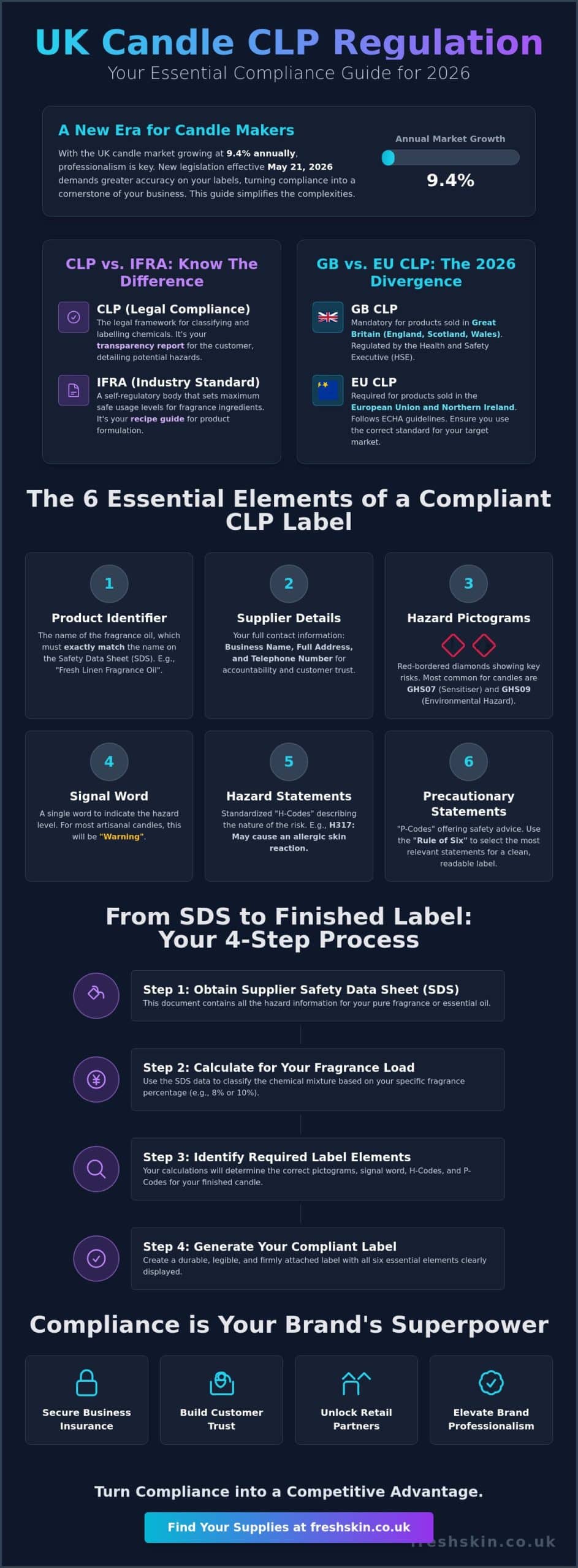
The 7 Essential Elements of a Compliant CLP Candle Label
Creating a label is a precise craft that marries aesthetics with safety. According to the CLP regulations for candles UK 2026, your label must be legible, durable, and firmly attached to the product. The product identifier is your first step; it must match the name on your fragrance oil’s Safety Data Sheet (SDS) exactly. If you use our crisp Fresh Linen Fragrance Oil, your label should state that name clearly so emergency services can identify the chemical mixture if needed. Your business name, address, and telephone number are also mandatory, providing a direct line of accountability and building trust with your customers.
Hazard Pictograms and Signal Words
Pictograms are the visual heart of safety. Most scented candles require GHS07 (the exclamation mark) for skin sensitisation or GHS09 (the dead tree and fish) for environmental toxicity. These red-bordered diamonds must be at least 10mm by 10mm if the label is small, or larger for bigger containers. You’ll also need a signal word. While “Danger” is reserved for severe hazards, “Warning” is the standard for most artisanal candles. Detailed HSE guidance on candles and CLP confirms that these elements must be grouped together on the label to ensure they aren’t missed by the consumer.
H-Codes and P-Codes: The Language of Safety
Hazard statements (H-codes) describe the nature of the risk, such as H317: “May cause an allergic skin reaction.” Precautionary statements (P-codes) offer advice on how to minimise adverse effects. To keep your label clean and readable, follow the ‘Rule of Six.’ This guideline suggests selecting the six most relevant precautionary statements, such as “Keep out of reach of children” or “Dispose of contents/container to approved disposal site.” This prevents information overload while maintaining high safety standards.
Supplemental Information and Allergen Listings
If your candle contains allergens like Limonene or Linalool above 0.1%, you must include the EUH208 statement. This lists the specific sensitisers to alert sensitive individuals before they handle the product. It’s helpful to use a clear, sans-serif font to ensure these lists remain legible even on smaller votives. When you source pure ingredients like our Peppermint Essential Oil, check the provided SDS to see which allergens must be declared. Starting with quality fragrance oils makes this documentation process much smoother and ensures your brand reflects a commitment to purity and transparency.
Navigating GB CLP vs. EU CLP: The 2026 Divergence
The regulatory landscape for candle makers has shifted into a dual-track system. Following the UK’s departure from the EU, Great Britain operates under its own framework known as GB CLP. While the core principles remain similar, we’re seeing a clear divergence as of May 2026. For instance, the EU recently introduced new hazard classes for endocrine disruptors and persistent chemicals. The Health and Safety Executive (HSE) hasn’t adopted these for Great Britain yet, though they intend to review these measures during 2026 and 2027. This means your labels for a local craft market in England might eventually look different from those required for the same candle sold in Europe.
Selling across the whole of the UK requires a strategy of dual compliance. Because of the Windsor Framework, Northern Ireland continues to follow EU CLP rules. If you’re shipping your Eucalyptus Essential Oil candles from a workshop in Wales to a boutique in Belfast, you must adhere to the EU standards. Managing these overlapping duties is a key part of being a professional maker. A helpful resource for understanding these practical safety standards is the Business Companion candle safety guide, which provides government-backed advice on meeting these requirements for home fragrance products.
The UFI Code: Requirements for 2026
The Unique Formula Identifier, or UFI, is a 16-character alphanumeric code that links your specific mixture to emergency health information. Since January 2025, a UFI has been mandatory for all new products placed on the market in Northern Ireland and the EU. For CLP regulations for candles UK 2026, while the HSE doesn’t currently require a UFI for sales strictly within Great Britain, many makers choose to include one anyway. This proactive approach ensures that if you expand your reach, your Fresh Linen Fragrance Oil creations are already prepared for international safety databases.
Poison Centre Notifications (PCN)
Registration is the final step in the safety chain for those selling in Northern Ireland or the EU. You must submit a Poison Centre Notification (PCN) through the ECHA portal, which connects your UFI code to a database used by medical professionals. This step is critical for any professional manufacturer who wants to ensure their customers are protected in the event of accidental exposure. It’s a process that reflects the transparency and care we put into every batch of Soy Wax Flakes we pour, turning technical data into a genuine trust signal for your brand.
How to Generate Accurate CLP Labels from Your Fragrance Oil SDS
Your Safety Data Sheet (SDS) is the most important document in your workshop. It isn’t just a technical requirement; it’s the blueprint for your customer’s safety. Most suppliers provide specific CLP templates calculated at 10% or 25% fragrance loads. When you’re creating a new batch with our Soy Wax Flakes, the first step is to download the template that matches your intended fragrance percentage. If you use a 10% template for a candle containing 12% oil, your label is legally incorrect under the CLP regulations for candles UK 2026. You must ensure the ‘Product Identifier’ on your label matches the name used on your marketing materials and the SDS exactly.
Reading Section 2.2 of a Safety Data Sheet
Section 2.2 of the SDS is often called the ‘gold mine’ for label creation because it contains the exact wording and symbols required for your mixture. It’s crucial to distinguish between the SDS for the ‘neat’ oil (the 100% concentrated liquid) and the ‘in-wax’ mixture SDS. Copying data from the neat oil document will lead to over-labelling, which can unnecessarily alarm your customers. Always verify that the pictograms and hazard phrases you transcribe come from the section specifically designated for the mixture. Common mistakes include copying ingredient lists from Section 3 instead of the hazard classifications in Section 2.2.
Small Packaging Exemptions and Label Placement
If you’re crafting smaller items, such as tea lights or votives under 125ml, certain exemptions apply. While you might be able to omit some precautionary statements to save space, the hazard pictograms and signal words must remain. The law is very clear that the label must be attached to the product itself, not just a removable box or a paper insert. This ensures that even after the packaging is discarded, the safety information remains with the candle throughout its life. It must also be clearly visible at the point of purchase, allowing customers to check for allergens like those found in Rosemary Essential Oil before they buy.
Fragrance Load and CLP Accuracy
Accuracy depends entirely on matching your recipe to the correct data. Before you start pouring, take a moment to learn how to choose the best fragrance oils for your candles to ensure you have the right documentation from the start. Once you’ve verified your fragrance load, you can confidently finish your label with your business contact details. If you’re ready to stock up on compliant supplies, you can browse our range of fragrance oils today. This attention to detail protects your business and provides your customers with the peace of mind they deserve.
Elevating Your Candle Brand Through Safety and Transparency
Compliance is often viewed as a hurdle, but for a premium brand, it’s a badge of honor. When you display your adherence to the CLP regulations for candles UK 2026, you’re telling your customers that their safety is your priority. High-end consumers are increasingly health-conscious and look for these markers of professional integrity. By featuring your commitment to safety on your ‘About Us’ page, you transform technical requirements into a powerful trust signal. At Freshskin, we support this journey by ensuring clear, accessible SDS data is available for every oil we provide, from our soothing Lavender Essential Oil to our vibrant Peppermint Essential Oil. This transparency builds a foundation of trust that faceless retailers simply can’t match.
Being an ethical maker means taking responsibility for the products that enter your customers’ homes. It’s about more than just avoiding fines; it’s about the peace of mind that comes from knowing your Fresh Linen Fragrance Oil candles are accurately labelled and safe for use. This ethical approach resonates deeply with modern audiences who value purity and honesty in the brands they support. When you treat safety data as a core part of your brand story, you position yourself as a partner in your customer’s wellness journey rather than just a seller of scents.
Designing Beautiful but Compliant Labels
You don’t have to sacrifice your brand’s aesthetic to remain legal. Many makers use ‘peel and reveal’ labels for smaller vessels, allowing the mandatory data to sit underneath a clean, minimalist top layer. This approach reassures the customer that the product is professional without cluttering the visual experience. The psychological impact of a well-designed safety label is significant. It suggests that if you’ve taken this much care with the paperwork, the quality of your Soy Wax Flakes and essential oils must be equally exceptional. It turns a legal requirement into a hallmark of luxury.
Building a Sustainable and Ethical Craft Business
Staying ahead of the CLP regulations for candles UK 2026 makes excellent business sense. It prevents the stress and expense of sudden rebranding or product recalls that can occur when regulations shift. By being a knowledgeable authority, you provide your community with the context they need to use your products safely and effectively. This proactive stance ensures your business remains resilient as the UK market continues its 9.4% annual growth. Your commitment to safety today is what ensures your brand’s longevity and reputation in the years to come.
Ready to craft with confidence? Explore our premium fragrance oils for candle making and download your SDS today to ensure your business remains a shining example of safety and quality.
Your Path to a Compliant and Confident Candle Business
Embracing the CLP regulations for candles UK 2026 is more than a legal necessity; it’s a commitment to the safety and well-being of your customers. By mastering the seven essential label elements and understanding the divergence between GB and EU standards, you’ve laid the groundwork for a truly professional brand. You now have the tools to navigate Safety Data Sheets with ease and turn technical data into a signal of quality and care.
At Freshskin, we’ve been supporting the UK maker community as a family-run business since 2010. We’re proud to be trusted by thousands of professional candle makers who value our comprehensive SDS and CLP templates. We provide the technical support you need so you can focus on the art of fragrance. Browse our range of CLP-ready fragrance oils for your 2026 candle collection and take the next step in your creative journey. Your dedication to excellence is what makes your craft special, and we’re here to help you shine every step of the way.
Frequently Asked Questions
Do I need a CLP label if I am only selling candles to friends and family?
Yes, you must have a label even for small-scale sales or gifts. The law defines “placing on the market” broadly to ensure that anyone using a chemical mixture is informed of potential hazards. Whether you’re gifting a jar of Lavender Essential Oil candle to a neighbour or selling at a local fair, compliance is about protecting the people you care about through transparency.
What happens if I don’t have CLP labels on my candles in the UK?
Failure to comply can lead to enforcement action from Trading Standards, including fines and the removal of your products from sale. Most importantly, your business insurance will likely be invalid without correct CLP regulations for candles UK 2026 documentation. This leaves you personally liable for any accidents, making compliance the ultimate safety net for your artisanal craft and professional reputation.
Is a UFI code mandatory for all candles sold in Great Britain in 2026?
For sales strictly within Great Britain, a UFI code is not currently a legal requirement in 2026, though it remains mandatory for Northern Ireland and the EU. Many professional makers choose to include one to maintain a high standard of safety and to simplify selling across the whole of the UK. It acts as a helpful link for emergency services, reflecting your commitment to consumer care.
Can I put the CLP label on the bottom of my candle jar?
You can place the CLP label on the bottom of the jar, provided it is clearly visible and remains attached during use. The key requirement is that the consumer can easily find and read the safety information before they light the wick. For smaller vessels where space is limited, ensure the font size remains legible and the pictograms meet the minimum 10mm size requirement.
Do unscented candles require CLP labelling?
Pure, unscented candles made from our Soy Wax Flakes typically don’t require CLP labelling. The regulations are triggered by hazardous substances, which are almost always found in fragrance or essential oils rather than the wax itself. If you add any dyes or chemical additives, you should check their specific Safety Data Sheets to ensure they don’t introduce new hazards that require disclosure.
How often do I need to update my CLP labels?
You should update your labels whenever your fragrance supplier issues a new Safety Data Sheet or when legislation changes significantly. For example, the May 2026 updates to GB CLP might influence how certain substances are classified over time. It’s a good habit to review your documentation annually to ensure your Peppermint Essential Oil blends remain perfectly compliant with the latest safety standards.
What is the difference between a 10% and a 25% CLP template?
These templates represent the concentration of fragrance oil within your wax mixture. A 10% template is designed for standard candles, while a 25% template is often used for high-scent products like wax melts. Using the wrong percentage makes your label legally inaccurate, so always match your specific recipe to the corresponding SDS data provided by your supplier to ensure total accuracy.
Does CLP apply to wax melts and reed diffusers as well?
Yes, CLP regulations apply to wax melts, reed diffusers, and room sprays just as they do to candles. These products are all considered chemical mixtures that can contain potential allergens or environmental hazards. Ensuring your Fresh Linen Fragrance Oil melts carry the correct labels is a vital step in maintaining a transparent and ethical home fragrance business that values customer safety above all else.