

Uncategorized
Best Essential Oils for Focus and Concentration: A 2026 Guide to Mental Clarity

May
What if the secret to conquering your mid-afternoon energy crash isn’t another cup of coffee, but a specific scent profile on your desk? We’ve all been there, staring at a screen while digital notifications chip away at our attention and brain fog sets in during a complex task. It’s frustrating to feel your productivity slip away when you need it most. Finding the best essential oils for focus and concentration can change that by anchoring your brain into a state of deep work through your limbic system.
In this 2026 guide, we’ll explore the science-backed botanical oils that sharpen your mind and transform your workspace into a powerhouse of clarity. You’ll discover a curated list of effective oils like Peppermint and Rosemary, alongside practical ways to use them in your home office. We’ll also dive into the latest safety standards, including the expanded EU allergen labeling and MoCRA requirements, so you can feel confident in the purity and integrity of your wellness rituals. From choosing the right carrier oil to understanding batch-specific testing, this journey is about empowering your mind with nature’s most potent tools.
Key Takeaways
- Understand the biological link between the olfactory bulb and your brain’s limbic system to help you trigger focus on demand.
- Discover which varieties, like Rosemary and Peppermint, are the best essential oils for focus and concentration based on their unique ability to support speed and accuracy.
- Learn how to establish a “Focus Anchor” ritual that prepares your mind for deep work while avoiding the sensory fatigue of constant scent saturation.
- Explore custom DIY recipes like the “Deadline Crusher” blend, specifically formulated to help you manage high-pressure tasks with clarity.
- Gain the confidence to identify high-quality botanical oils, ensuring your workspace remains a healthy environment free from the headaches caused by synthetic fillers.
The Science of Scent: How Essential Oils Influence Cognitive Focus
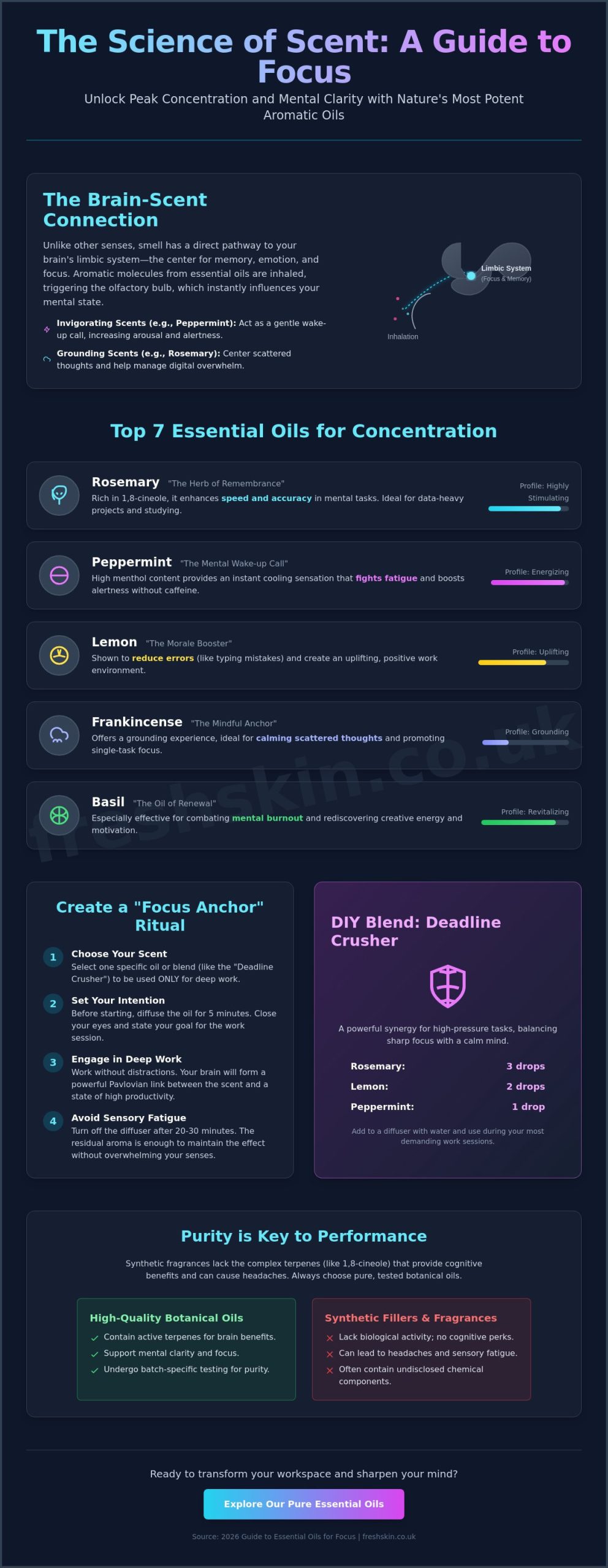
Smell is unique. Unlike your other senses, which must be processed through the brain’s relay station before reaching your consciousness, scent has a direct highway to your emotional center. When you inhale the best essential oils for focus and concentration, the aromatic molecules interact with the olfactory bulb. This structure is physically connected to the limbic system, the part of your brain responsible for emotions, memories, and arousal. The Science of Scent shows that this immediate connection is why certain aromas can instantly shift your mental state.
By choosing specific oils, you can trigger the release of neurotransmitters like dopamine. This chemical is essential for motivation and cognitive control. You’ll often find that scents fall into two primary categories: invigorating and grounding. Invigorating scents, like Peppermint, act as a gentle wake-up call for the nervous system, increasing physiological arousal. Grounding scents, like Rosemary, help center your thoughts when you feel scattered or overwhelmed by digital notifications. You can use this to your advantage through scent anchoring. By diffusing the same oil only during deep work sessions, you create a Pavlovian habit where your brain recognizes the scent as a signal to enter a high-productivity mode.
The Olfactory Connection to Memory and Learning
Smell is the only sense that bypasses the thalamus, linking directly to the amygdala and hippocampus. This explains why a single whiff can bring back a vivid memory from years ago with startling clarity. For students or professionals, this connection supports memory retention by creating a multi-sensory learning environment. Aromatic molecules are small enough to cross the blood-brain barrier, allowing them to interact directly with the central nervous system.
Terpenes: The Chemical Drivers of Mental Clarity
The effectiveness of botanical oils comes from their complex chemical makeup. Rosemary is particularly rich in a compound called 1,8-cineole. Research suggests this terpene may improve both speed and accuracy during mental tasks by interacting with the pathways involved in memory. Citrus oils often contain high levels of limonene, which is known for its ability to elevate mood and increase alertness. These natural compounds differ significantly from synthetic fragrances. While a laboratory-made scent might smell pleasant, it lacks the biological activity of pure botanical extracts and can often lead to headaches or sensory fatigue rather than the mental clarity you need to finish a project.
The Top 7 Essential Oils for Concentration and Mental Clarity
Selecting the right botanical extract requires understanding your specific mental needs. While some scents energize, others calm a racing mind. This selection represents the best essential oils for focus and concentration, each offering a unique pathway to clarity. According to research cited by Johns Hopkins Medicine on aromatherapy, these oils work by stimulating the brain’s emotional center through the olfactory system, providing a natural way to manage your cognitive state.
Rosemary is often called the “Herb of Remembrance” for good reason. It contains high levels of 1,8-cineole, which has been linked to increased speed and accuracy during complex mental tasks. It’s the perfect companion for anyone managing data-heavy projects or studying for exams. Peppermint brings an immediate chill that wakes up the senses. Its high menthol content increases physiological arousal, making it an excellent tool for fighting off the afternoon slump without reaching for more caffeine. Lemon is a favorite in office environments because it’s been shown to reduce typing errors and boost overall morale. Frankincense offers a more grounding experience; it’s ideal for those moments when your thoughts feel scattered and you can’t seem to pick a single task. Basil, known as the “Oil of Renewal,” is particularly effective when you’re facing mental burnout and need to rediscover your creative spark. Eucalyptus helps clear the airways and promotes a sense of open, expansive thinking. Finally, Lavender can be surprisingly effective for focus when that focus is blocked by anxiety or stress.
Stimulating Oils for Morning Productivity
Rosemary is the gold standard for analytical work. It helps sharpen the mind without the jittery side effects of caffeine. If you’re looking for a deeper dive into its many uses, check out this guide on Rosemary Essential Oil. For those who find themselves reaching for a third cup of coffee, try diffusing Peppermint instead. It provides a clean, crisp energy that clears the cobwebs from your brain. You’ll find that these stimulating oils create a sense of urgency and alertness that is perfect for tackling your most difficult tasks first thing in the morning.
Grounding Scents for High-Stress Deadlines
During high-stress deadlines, you need stability. Frankincense and Cedarwood provide a mental anchor that prevents panic from setting in when the clock is ticking. Sweet Orange is another excellent choice; it balances focus with stress reduction by keeping your mood light and optimistic. For creative problem-solving, Clary Sage is a secret weapon that encourages “out of the box” thinking while keeping you calm. These oils ensure that even when the pressure is on, your mind stays clear and your decisions remain logical. If you’re ready to start your focus ritual, exploring a high-quality Rosemary Essential Oil is a great first step toward reclaiming your productivity.
Creating Your Focus Environment: Scent Rituals for Deep Work
True productivity requires more than just willpower. It’s about designing an ecosystem where your brain feels safe and stimulated. A Focus Anchor ritual is one of the most effective ways to achieve this. By introducing one of the best essential oils for focus and concentration at the start of your deep work session, you build a mental bridge between that specific aroma and your state of flow. Over time, your mind recognizes the scent as a non-negotiable signal to ignore digital notifications and settle into the task at hand. This ritual becomes especially powerful when you pair it with a dedicated workspace, creating a multi-sensory boundary between your professional and personal life.
It’s tempting to keep your diffuser running all day, but constant scent saturation can lead to olfactory fatigue. When your brain is constantly exposed to a stimulus, it eventually tunes it out to prevent sensory overload. To maintain cognitive effectiveness, follow the 30-minutes on, 30-minutes off rule. This intermittent exposure keeps the limbic system engaged without overwhelming it, ensuring the botanical molecules continue to support your mental clarity throughout the day. At the end of your session, transitioning out of work mode is just as important. Switching your environment to a relaxing scent like Lavender signals to your nervous system that it’s time to decompress, preventing the mental fatigue that often lingers after a long day of complex tasks.
Diffusion Strategies for the Home Office
Choosing the right delivery method depends on your workspace size and personal preference. Ultrasonic diffusers are excellent for consistent, humidified mist in larger rooms, while passive inhalation is better for shared spaces. You can simply place a few drops of Rosemary or Peppermint on a tissue or an aroma stone for a localized “scent bubble” that won’t disturb others. For more detailed advice on choosing the right tools for your space, our Aromatherapy Guide 2026 offers comprehensive equipment tips and safety protocols to ensure your setup is both effective and safe.
Synergistic Workspace Habits
Aromatherapy works best when it’s integrated with other healthy habits. Pairing Lemon oil with plenty of natural light helps maintain your circadian rhythm, keeping your energy levels stable during the morning hours. If you feel a 3 PM energy slump approaching, use Peppermint as a sensory reboot. Its cooling effect provides an immediate lift that clears brain fog better than a sugary snack. There’s also a significant psychological benefit to a clean workspace paired with “clean” scents. In 2026, over 70% of buyers prioritize transparency and purity in their products. Using high-quality, ethically sourced oils in a tidy office reinforces a sense of order and professional integrity, making it easier to stay focused on high-speed tasks.
DIY Focus Blends: Practical Recipes for Study and Work
Creating your own aromatic synergy is a rewarding way to personalize your productivity. While individual oils are powerful, blending allows you to target specific cognitive needs, such as the difference between high-pressure analytical work and expansive brainstorming. By combining the best essential oils for focus and concentration, you can produce a scent profile that evolves throughout your work session, providing both an immediate mental spark and a lasting sense of clarity. These recipes are designed to be used in a diffuser or as a topical pulse-point application when you’re away from your desk.
- The Deadline Crusher: Use this for high-speed tasks that require intense accuracy. Blend 3 drops of Rosemary, 2 drops of Lemon, and 1 drop of Peppermint. The Rosemary supports memory, while the Peppermint provides the physiological arousal needed to push through a heavy workload.
- The Creative Flow: This blend is perfect for brainstorming and open-ended projects. Mix 3 drops of Bergamot, 2 drops of Frankincense, and 1 drop of Basil. The Frankincense grounds your thoughts, preventing them from becoming scattered, while the Basil offers a sense of mental renewal.
- The Late Night Scholar: For those sustained study sessions, combine 3 drops of Eucalyptus, 2 drops of Rosemary, and 1 drop of Lemon. The Eucalyptus helps clear the mind and keep the airways open, which is essential for maintaining alertness during long periods of sitting.
Mastering the Focus Blend Ratios
Successful blending often follows the 3-2-1 rule. This simple ratio ensures a balanced aromatic profile that doesn’t overwhelm the senses. You should let your top notes, like citrus oils, lead the blend. These molecules are the lightest and reach your olfactory system first, providing that immediate sense of alertness. To make the focus effect last longer, incorporate base notes like Frankincense. These heavier molecules evaporate slowly, anchoring the lighter oils and ensuring your workspace stays productive for hours. It’s a rhythmic approach to scent that mirrors a steady, focused heartbeat.
Safe Topical Application for the Desk
If you prefer a more personal scent experience, a pulse-point roller is a convenient tool. You must choose the right carrier oils to ensure skin safety and prevent irritation. Golden Jojoba Carrier Oil is a favorite for office use because its chemical structure is similar to our skin’s natural sebum, making it highly absorbent and non-greasy. You won’t have to worry about leaving oily marks on your keyboard or documents.
To make a 10ml focus rollerball, follow these steps:
- Add 6 drops of your chosen essential oil blend to a 10ml amber glass bottle. This creates a safe 2% dilution for daily adult use.
- Fill the rest of the bottle with Golden Jojoba or Fractionated Coconut Oil.
- Secure the rollerball attachment and shake gently to combine.
Applying this to your wrists or temples during a 3 PM slump provides a sensory reboot that keeps you grounded. You can browse our pure essential oils to find the perfect ingredients for your next custom focus blend.
Why Purity is the Key to Cognitive Performance
Using the best essential oils for focus and concentration is only effective if the volatile compounds within the bottle are unadulterated. Many products found on the market are synthetic “fragrance oils” designed for scent alone, lacking the biological complexity needed to support mental tasks. Adulterated oils often contain hidden solvents or fillers that can trigger sensory irritation or headaches, which actively works against your productivity goals. For a health-conscious UK audience, ensuring that an oil is a true botanical extract is the final, most critical step in building a reliable focus ritual.
In 2026, UK labeling standards have become more rigorous to protect consumers. Following Regulation (EU) 2023/1545, over 80 fragrance allergens must now be declared if they occur naturally in the oil. When inspecting a label, look for the specific Latin name and the country of origin. A high-quality Rosemary oil, for instance, should clearly state Rosmarinus officinalis to distinguish it from other species that may not offer the same cognitive profile. This level of transparency is what separates professional-grade supplies from generic alternatives.
The Freshskin Beauty Ltd Promise: From Grower to Your Desk
At Freshskin Beauty Ltd, we operate as a family-run business with over 15 years of experience in sourcing premium botanical ingredients. Our direct-to-consumer model is designed to ensure that the oils you receive are as fresh as possible, which is a vital factor for the stability of citrus and herb-based extracts. By cutting out middle-market distributors, we maintain a strict “purity first” philosophy that resonates with our community of natural living enthusiasts. This hands-on approach to sourcing allows us to provide technical data and batch-specific quality guarantees for every product we offer.
Safety Precautions for Daily Use
Integrating these powerful extracts into a home office requires a mindful approach to safety. If you share your workspace with pets or young children, always ensure the room remains well-ventilated and allow them the freedom to exit the space if the aroma becomes too concentrated. You should also be aware of olfactory fatigue; if a scent seems to disappear after a short period, it’s a sign that your receptors are saturated and it’s time for a break. To preserve the integrity of your focus oils, store them in their original amber glass bottles away from direct sunlight. This simple step prevents oxidation, ensuring your investment in mental clarity lasts as long as possible.
Empower Your Mind with Botanical Clarity
Transitioning from a cluttered, distracted mind to a state of sharp, intentional flow is a journey that starts with your environment. By applying the science of scent and the practical blending techniques we’ve discussed, you now have the tools to anchor your brain into high-performance mode. Finding the best essential oils for focus and concentration isn’t just about a pleasant smell; it’s a strategic move to optimize your cognitive health using nature’s most potent molecules. When you choose botanical purity over synthetic alternatives, you’re choosing a clearer, more sustainable path to productivity.
With over 15 years of experience sourcing premium botanical oils, Freshskin Beauty Ltd is a trusted partner for UK hobbyists and wholesale manufacturers alike. We take pride in our heritage and our commitment to transparency, ensuring you receive only the highest quality supplies for your workspace. You can Shop our curated Focus & Concentration Collection today and enjoy fast UK delivery. Your wellness journey is personal, and we’re here to provide the pure, ethical ingredients you need to thrive. Let’s make your next work session your most productive yet.
Frequently Asked Questions
Can I use essential oils for ADHD focus support?
Essential oils aren’t a medical treatment for ADHD, and you should always follow the advice of a healthcare professional for clinical conditions. Many people find that incorporating certain scents helps create a structured environment that supports attention. Rosemary and Peppermint are popular choices for those looking for the best essential oils for focus and concentration to help anchor their mind during repetitive tasks.
How long should I diffuse essential oils for concentration?
The most effective method is to diffuse for 30 minutes, followed by a 30-minute break. This intermittent approach prevents olfactory fatigue, a state where your brain stops noticing the scent because it has become a constant background stimulus. Keeping the exposure rhythmic ensures your limbic system remains responsive to the botanical molecules throughout your workday.
Which essential oil is best for memory retention during exams?
Rosemary is widely regarded as the superior choice for memory support. It’s rich in 1,8-cineole, a compound that research suggests can improve both speed and accuracy during mental challenges. Using Rosemary as one of the best essential oils for focus and concentration during study sessions can help you establish a strong sensory link to the material you’re learning.
Is it better to inhale oils directly or use a diffuser for focus?
Both methods have their place in a productive workspace. A diffuser is ideal for maintaining a consistent, supportive atmosphere in your home office over several hours. Direct inhalation from a tissue or an amber glass bottle provides a more immediate, intense sensory “reboot” that’s perfect for overcoming a sudden energy crash or a moment of deep distraction.
Are there any essential oils I should avoid while working?
You should generally avoid heavily sedative oils like Valerian or excessive amounts of Ylang Ylang when you need to stay sharp. While Lavender is excellent for calming stress, using it in high concentrations might make you feel too relaxed or sleepy for complex tasks. Stick to invigorating top notes like Peppermint or Eucalyptus to keep your physiological arousal levels high.
Can I use fragrance oils instead of essential oils for productivity?
Fragrance oils like Fresh Linen or Baby Powder are wonderful for scenting a room, but they don’t offer the same cognitive benefits as pure essential oils. Productivity is driven by the natural terpenes found in plant extracts, which interact with your brain’s chemistry. Synthetic fragrances lack these complex biological compounds, so they won’t trigger the same neurotransmitter response as a botanical oil.
How many drops of essential oil should I put in my desk diffuser?
For a standard 100ml desk diffuser, 3 to 5 drops of essential oil are usually sufficient. In a smaller home office, a high concentration can become overwhelming and may lead to a headache rather than improved clarity. It’s always better to start with a smaller amount and increase it slightly if you find the aroma too faint for your preference.
Can I apply focus oils directly to my temples?
You can apply oils topically, but they must be diluted in a carrier oil first to protect your skin. Mix 1 or 2 drops of your chosen essential oil with a teaspoon of Golden Jojoba Carrier Oil or Sweet Almond Carrier Oil before dabbing it onto your pulse points. This prevents irritation while allowing the scent to stay close to your nose as you work at your desk.