
Uncategorized
Soy Wax Candle Making Temperature: The Ultimate 2026 Guide to the Perfect Pour
May
The most expensive fragrance oil in the world won’t save a candle if you haven’t mastered the invisible science of heat. Achieving the perfect soy wax candle making temperature is the single most important skill for any maker, yet it’s often the most misunderstood. You’ve likely felt the frustration of a beautiful candle that refuses to throw a scent or wakes up the next morning with unsightly frosting and deep cracks. It’s confusing when online tutorials offer conflicting numbers, leaving you to wonder if your process is truly reliable.
We believe that candle making should be a calming, therapeutic ritual rather than a guessing game. This guide promises to clear the confusion by providing the precise temperature stages needed for a professional finish and a room-filling aroma every time. We’ll walk you through the three-stage lifecycle of melting, binding, and setting. You’ll learn how to handle your soy wax flakes with the care they deserve, ensuring your 2026 creations meet the highest standards of quality and safety while delivering the clean, luxury experience your home deserves.
Key Takeaways
- Understand the polymorphic nature of soy wax flakes and how precise heat management prevents structural flaws in your finished products.
- Identify the optimal soy wax candle making temperature for the melting phase to avoid scorching and preserve the purity of your ingredients.
- Learn the critical “binding” window for adding fragrance or essential oils to ensure a deep, room-filling scent throw when the candle is lit.
- Master the cooling and pouring process to achieve smooth, creamy tops while eliminating common issues like frosting, sinkholes, and surface cracking.
The Science of Soy: Why Temperature is the Secret to Success
Temperature is the invisible hand that guides every successful pour. In the world of botanical crafting, finding the “Goldilocks Zone” for your soy wax candle making temperature means the difference between a luxury finish and a frustrating mess. A few degrees might seem trivial; however, they dictate how molecules align and how oils bond within the wax structure. It’s not just about melting flakes. It’s about managing a delicate chemical transition that transforms raw materials into a therapeutic household staple.
You may have heard the term “wax memory” in community forums. While it’s a popular phrase, the reality is rooted in crystal formation rather than a conscious memory. As soy wax transitions from liquid to solid, it seeks a state of equilibrium. If the environment is too cold or the cooling happens too fast, the crystals form haphazardly. This creates the structural flaws that ruin a professional aesthetic. To master this craft, you must respect three critical milestones:
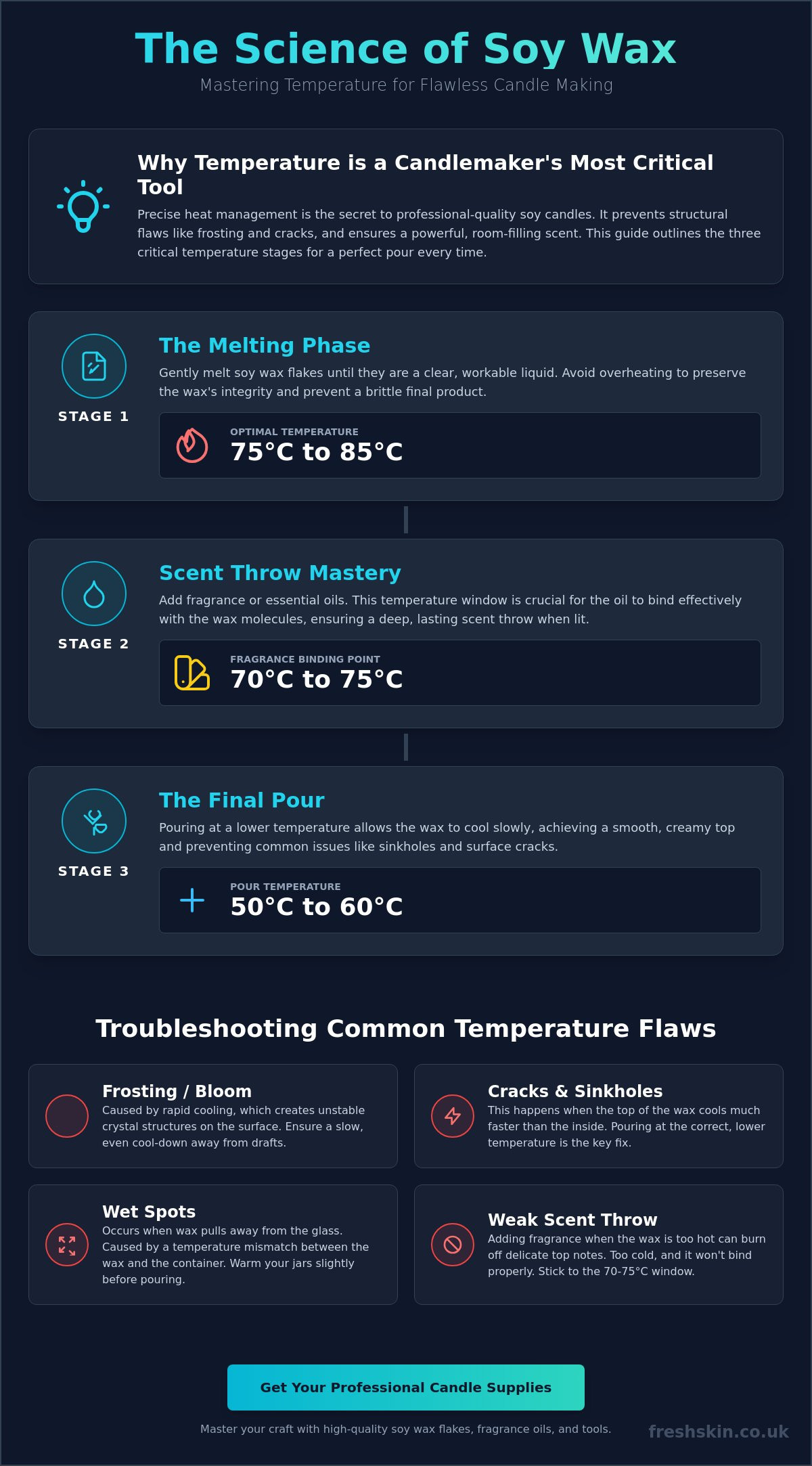
- Melting Point: The threshold, typically between 75°C and 85°C, where soy wax flakes become a clear, workable liquid.
- Fragrance Binding Point: The specific window, often between 70°C and 75°C, where oils can successfully integrate with wax molecules.
- Pour Temperature: The moment the wax reaches 50°C to 60°C and is ready to enter the jar without causing surface tension issues.
Understanding the Polymorphic Nature of Soy
Soy wax is naturally polymorphic. Polymorphism in soy wax is the ability to solidify into various crystalline forms. When you study The Science of Soy, you’ll see that these crystals are sensitive to thermal changes. Managing your soy wax candle making temperature during this phase is vital. Rapid cooling leads to unstable, jagged crystal structures, which manifest as frosting or bloom on the surface. You’ll know you’ve achieved a proper temper when the wax looks creamy and opaque as it sets, indicating a stable molecular bond that will last the life of the candle.
The Consequences of Temperature Errors
Errors in heat management lead to “wet spots,” which occur when the wax delaminates from the glass container. This usually happens when there’s a significant temperature mismatch between the jar and the wax. Additionally, adding oils at the wrong time can be disastrous for your results. Overheating the mixture often destroys the delicate fragrance bonds before the candle even has a chance to set. This is a common pitfall when working with high-quality botanical extracts. You can explore our essential oils guide to better understand how oil volatility affects your final scent throw. Precision is your best tool for ensuring a room-filling aroma and a flawless, professional finish.
The Melting Phase: Reaching the Optimal Temperature Without Scorching
Melting your wax is the first physical step in your candle making journey. While it seems simple, maintaining the correct soy wax candle making temperature is essential for preserving the wax’s botanical integrity. You should aim for a melting range between 75°C and 85°C. This ensures that every flake is completely liquefied, which is a requirement for a smooth, uniform pour later on. Heating beyond this point risks scorching the material, leading to a brittle candle that lacks the creamy texture we strive for. Precision is your best friend here. A digital probe thermometer with ±1°C accuracy is a non-negotiable tool for any serious maker, as even a small variance can impact how your wax behaves during the binding stage.
When you’re handling larger batches, temperature control becomes even more critical. Bulk melting requires patience. If you rush the process by turning up the heat, the wax at the bottom of your vessel may scorch before the flakes at the top have even begun to soften. We recommend a steady, rhythmic approach. By monitoring the soy wax candle making temperature throughout the entire melting cycle, you ensure a consistent molecular structure. This consistency is what allows your finished candles to burn evenly and look beautiful on a shelf. Starting with high-quality soy wax flakes provides a reliable foundation for this process.
The Double Boiler Method: A DIY Essential
Steady, indirect heat is the safest way to prepare your wax. You can easily set up a safe bain-marie by placing a pouring jug inside a large pot filled with a few inches of water. Bring the water to a gentle simmer, allowing the rising steam to melt the wax flakes slowly. This method prevents the wax from reaching its fire point and ensures the heat is distributed evenly across the liquid. Safety is paramount in our community. Never leave melting wax unattended, and always keep a close eye on your thermometer to prevent the water from boiling dry.
Recognizing and Avoiding Overheated Wax
Scorched wax is easy to identify if you know what to look for. It often develops a yellow or brown discolouration and gives off a sharp, acrid smell that can ruin your workspace’s atmosphere. When fully and safely melted, soy wax should be clear and straw-coloured. If you find your wax has exceeded 90°C, take it off the heat immediately. You can safely cool it by gently stirring or adding a few un-melted flakes to bring the temperature down. Once the heat is under control, you can begin focusing on reaching the specific temperature for adding fragrance. This transition is where the real magic of scent throw begins to happen.
Scent Throw Mastery: Adding Fragrance and Essential Oils at the Right Moment
The moment you introduce scent to your liquid wax is a turning point in the creation process. Achieving the perfect soy wax candle making temperature during this stage is what separates a faint, disappointing candle from one that fills a room with aroma. For most standard fragrance oils, the critical window for addition lies between 70°C and 75°C. At this specific heat level, the wax molecules have expanded sufficiently to create a “binding” effect. This physical expansion allows the wax to effectively trap the oil droplets, ensuring they’re locked within the structure as the candle solidifies. If you’re currently exploring fragrance oils for your next project, remember that timing and patience are your most valuable tools.
Once the oil is added, stirring is not a step to be rushed. You should stir the mixture gently but continuously for exactly two minutes. This isn’t just a suggestion; it’s a requirement for a complete chemical bond. Without this thorough integration, the oil may settle at the bottom or “bleed” from the wax later on, leading to poor burn quality and potential safety hazards. A steady, rhythmic stir ensures the scent is distributed evenly, providing a consistent experience from the first light to the final burn.
Flashpoints: The Invisible Temperature Limit
Every scent has a flashpoint, which is the temperature at which the oil’s vapours can ignite if exposed to an open flame. More importantly for makers, it’s also the point where the scent begins to evaporate rapidly. If you add your oils when the soy wax candle making temperature is too high, you’re essentially “burning off” the fragrance before the candle is even poured. High-flashpoint oils are often more forgiving for beginners because they remain stable at higher temperatures. Always check the specific data sheets for your oils to adjust your addition window accordingly.
Essential Oils vs. Fragrance Oils: Temperature Tweaks
Essential oils require a gentler touch than synthetic fragrances. Because these are pure botanical extracts, excessive heat can degrade their delicate therapeutic properties and alter their natural profile. For example, rosemary oil is a favoured choice for wellness-focused candles, but it thrives when added at a slightly lower heat to preserve its crisp, herbal aroma. Using a lower temperature ensures the integrity of the plant’s essence remains intact.
| Scent Category | Recommended Addition Temperature |
|---|---|
| Standard Fragrance Oils | 70°C – 75°C |
| Woody Essential Oils | 65°C |
| Citrus Essential Oils | 60°C |
The Final Pour: How Cooling Temperatures Affect Your Candle’s Finish
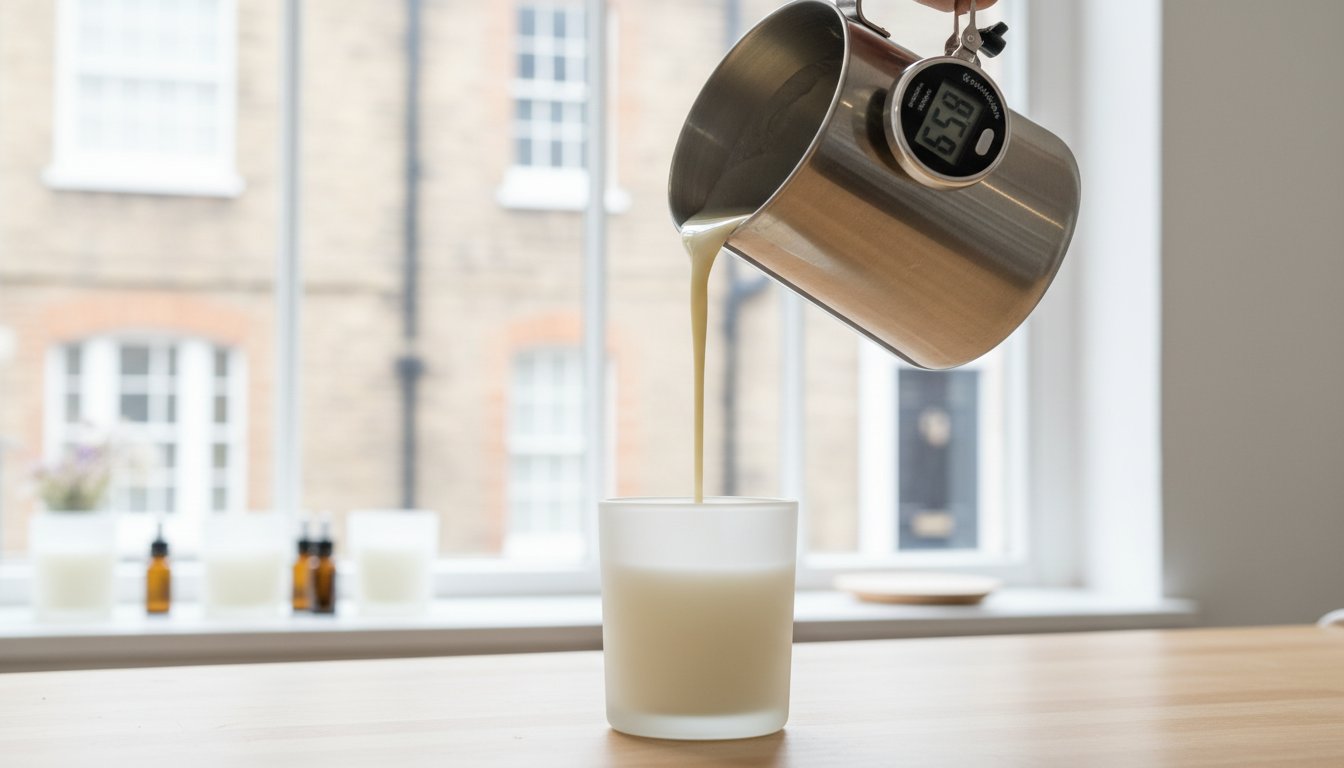
The transition from the mixing jug to the glass jar is the most delicate stage of the process. If you want a professional result, finding the right soy wax candle making temperature for the pour is non-negotiable. Most makers find that pouring between 50°C and 60°C is the sweet spot. When you pour at this lower heat, the wax is closer to its solid state, which reduces the amount of shrinkage that occurs as it cools. Pouring while the wax is too hot often leads to deep sinkholes and hidden caverns around the wick. These internal air pockets don’t just look poor; they can cause dangerous flare-ups or uneven burning later on.
For those seeking a truly flawless, creamy finish, the “Slushy Pour” technique is a valuable skill to develop. This involves waiting until the wax begins to look slightly cloudy or opaque in the jug, typically around 45°C to 50°C. By pouring at this cooler stage, you encourage the wax to set quickly and uniformly. This minimizes the time the wax has to form large, unstable crystals. If you are starting with high-quality soy wax flakes, this technique helps highlight the natural, luxurious texture of the botanical material. By carefully managing your soy wax candle making temperature during the final pour, you eliminate the risk of internal air pockets that compromise your work.
Jar Preparation and Ambient Temperature
Your environment plays a massive role in the final look of your candle. Cold glass is the primary enemy of a good finish. When warm wax hits a cold jar, it shrinks away from the sides instantly, creating unsightly “wet spots” or delamination. We recommend pre-warming your jars to approximately 40°C in a low oven before you pour. This promotes even adhesion and a professional seal. Additionally, ensure your workspace is free from draughts and maintained at a consistent room temperature of 20-22°C. If you do spot minor surface imperfections after the candle has set, a quick pass with a heat gun on its lowest setting can often smooth the top without resetting the entire pour.
The Curing Phase: Patience as a Temperature Tool
Patience is just as important as your thermometer. Once your candle is poured, it needs 1-2 weeks to fully cure. During this time, the soy wax completes its polymorphic transition, stabilizing the crystal structure you worked so hard to create. This stabilization is what allows the fragrance to develop its full potential. Avoid the temptation to test-burn your creation early. Lighting the wick too soon introduces heat that resets the curing process, often resulting in a weaker scent throw and an uneven melt pool. Give your candles the time they need to reach their peak performance.
Troubleshooting Temperature Flaws with Professional Candle Supplies
Perfecting your soy wax candle making temperature is a journey of refinement. Even with the most careful preparation, environmental variables can sometimes lead to unexpected results. Troubleshooting is not a sign of failure; rather, it’s an essential part of mastering the botanical craft. When you understand why a flaw occurs, you gain the power to prevent it in your future batches. Most aesthetic issues are simply the wax’s way of reacting to a thermal shock or a timing error during the binding phase.
Frosting, often referred to as bloom, is perhaps the most common challenge for soy makers. These white, crystalline structures appear because the wax is attempting to return to its natural state. While some enthusiasts view this as a hallmark of pure soy, you can significantly reduce its appearance by slowing down the cooling rate. When the soy wax candle making temperature drops too rapidly, the crystals form unevenly. By insulating your jars or adjusting your workspace environment, you encourage a more graceful transition from liquid to solid. This creates the smooth, creamy finish that characterizes high-end, professional candles.
If your finished candle lacks a room-filling aroma, the diagnosis usually involves the oil addition stage. Adding oil when the wax is too hot causes the delicate scent notes to evaporate before they can bind. Conversely, adding it when the temperature is too low prevents the molecules from “trapping” the fragrance effectively. Achieving a professional result starts with the right materials. High-quality Soy Wax Flakes are the foundation of success, providing the stability needed for consistent scent throw and structural integrity.
Solving Aesthetic Imperfections
Rapid temperature shifts are the primary cause of surface cracks and sinkholes. You can create a simple “cooling chamber” by placing your poured candles inside a cardboard box, which traps the residual heat and slows the cooling process. For deep sinkholes in larger containers, the “double pour” method is an effective fix. Simply save a small amount of your scented wax, reheat it gently, and pour a thin layer over the set surface to fill any internal voids. To smooth out bumpy tops or minor surface imperfections, use a heat gun on the lowest setting to gently melt the top millimetre of wax.
Why Quality Ingredients Matter
The purity of your wax directly impacts its melting point and overall stability. Impurities can cause the wax to behave unpredictably, leading to inconsistent results even when your temperatures are precise. Using high-load fragrance oils also ensures that the scent remains potent through the various heat cycles of melting and burning. Freshskin Beauty Ltd focuses on providing premium, ethically sourced supplies for the UK market because we believe that quality ingredients are the partner to your expertise. By combining precise heat management with superior botanical materials, you ensure that every candle you create is a testament to your dedication to the craft.
Elevate Your Craft with Thermal Precision
Mastering the science of heat turns candle making from a guessing game into a reliable, therapeutic art form. By respecting the precise windows for melting, binding fragrance, and pouring into pre-warmed jars, you eliminate the common frustrations of frosting and poor scent throw. Every batch you create is an opportunity to refine your soy wax candle making temperature and achieve a professional finish that reflects your dedication to quality and purity.
Since 2010, Freshskin Beauty Ltd has operated as a family-run UK business dedicated to the well-being of our community. We provide directly sourced, high-purity ingredients that meet the highest ethical standards. With our commitment to transparency and fast national delivery across the UK, you can trust that your supplies will arrive ready for your next creative session. Having the right tools and knowledge is the first step toward crafting candles that bring comfort and luxury to any space.
Ready to begin your next project? Explore our premium range of Soy Wax Flakes and Fragrance Oils at Freshskin Beauty Ltd. We’re excited to be a partner in your wellness journey as you create beautiful, room-filling aromas with confidence and ease.
Frequently Asked Questions
What is the best temperature to add fragrance oil to soy wax?
The optimal window for adding fragrance oil is between 70°C and 75°C. At this stage, the wax molecules have expanded enough to allow the oil to bind effectively without the heat causing the scent to evaporate. Achieving this specific soy wax candle making temperature ensures that the fragrance is “trapped” within the structure, leading to a much stronger scent throw when the candle is eventually lit.
Can I melt soy wax in a microwave if I don’t have a double boiler?
You can use a microwave for small batches, though it offers less control than a traditional double boiler. Use a microwave-safe container and heat the wax in 30-second bursts, stirring well between each interval to prevent localized hot spots. It’s vital to use a digital thermometer to check the temperature frequently, as the microwave can quickly push the wax beyond its safe melting point and cause scorching.
Why does my soy candle have a bumpy top after cooling?
Bumpy or uneven tops are usually the result of air being trapped during the pouring process or the wax cooling at an inconsistent rate. If you stir too vigorously or pour the wax into a very cold jar, the surface can set prematurely and create a rough texture. Ensuring your workspace is draught-free and pouring at a slightly lower temperature, around 50°C to 55°C, often solves this aesthetic issue.
What happens if I add fragrance oil to soy wax at 85°C?
Adding fragrance oil at 85°C is generally too high and can cause the oil to “burn off” or evaporate before it has a chance to bind with the wax. This significantly weakens the final scent throw of your candle. It’s much better to let the wax cool into the 70°C to 75°C range so that the delicate aromatic compounds remain stable and integrated into the wax’s crystalline structure.
Do I need to pre-heat my glass jars before pouring the wax?
Pre-heating your jars is a highly recommended step for achieving a professional, high-end finish. When warm wax hits cold glass, it shrinks away instantly, creating unsightly gaps known as “wet spots.” Warming your jars to approximately 40°C in a low oven helps the wax adhere smoothly to the sides, resulting in a clean and clear appearance through the glass.
What is the “flashpoint” of fragrance oil and why does it matter?
A flashpoint is the specific temperature at which an oil’s vapour can ignite if exposed to an open flame. In candle making, it also serves as a guide for scent stability. If you consistently exceed the flashpoint during the mixing stage, you risk losing the top notes of your fragrance. Respecting the soy wax candle making temperature guidelines helps you stay well below these limits for a safer and more aromatic result.
How long should I stir the fragrance oil into the melted wax?
You should stir the mixture gently and continuously for exactly two minutes. This duration is necessary to ensure that the oil and wax have formed a complete chemical bond. Rushing this step can lead to the oil settling at the bottom of the jar or “bleeding” out of the wax as it sets, which compromises both the scent and the safety of the burn.
Why is my soy candle frosting (turning white and powdery)?
Frosting is a natural characteristic of pure soy wax, caused by the formation of tiny crystals on the surface as the wax cools. While it doesn’t affect the burn quality or scent, you can minimize it by slowing down the cooling process. Placing your candles in a cardboard box or a dedicated “cooling chamber” helps maintain a steady temperature, preventing the rapid crystal growth that leads to a powdery appearance.