
Uncategorized
How to Make Scented Candles at Home: The Ultimate Beginner’s Guide (2026)

Feb
Have you ever poured your heart into creating a beautiful candle, only for it to crack, tunnel, or worse, have almost no scent when you finally light it? It’s a common frustration for aspiring artisans, but achieving that professional, boutique-quality finish is simpler than you might think. This comprehensive guide is designed to teach you exactly how to make scented candles at home that not only look stunning but also fill your space with a rich, therapeutic aroma, every single time.
As a UK-based, family-run company passionate about pure, botanical ingredients, we believe in empowering you with trusted, transparent knowledge. We’ll guide you through the science of selecting the right natural waxes, precisely calculating fragrance loads for a powerful scent throw, and mastering the art of the perfect pour. You will learn to create safe, eco-friendly candles that look as beautiful as they smell, transforming your space and making for truly thoughtful, handcrafted gifts.
Key Takeaways
- Understand why choosing the right wax and wick size is the essential foundation for creating candles that burn cleanly and evenly.
- Master the simple calculation for fragrance load, a crucial safety step when learning how to make scented candles at home for a powerful, consistent aroma.
- Discover how to easily correct common issues like frosting and sinkholes to achieve a flawless, professional finish on every candle you pour.
- Move beyond single scents by learning the basics of aromatherapy notes to create your own signature, therapeutic blends with confidence.
The Foundation: Essential Supplies for Making Scented Candles at Home
Embarking on your candle-making journey begins with gathering the right tools. Just like any craft, the quality of your finished product is a direct reflection of the quality of your ingredients and equipment. Investing in the correct foundational supplies not only ensures a beautifully fragrant candle but also a safe and enjoyable creative process. This guide will walk you through the essential items you need to master how to make scented candles at home, focusing on purity, performance, and safety from the very first step.
Selecting the Right Wax for Scent Throw
Your choice of wax is the most critical decision you’ll make. While the history of candle making includes materials like tallow and paraffin, we advocate for natural soy wax. Unlike traditional paraffin wax, which is a petroleum by-product, soy wax is a renewable, biodegradable resource that produces a cleaner, soot-free burn. We recommend our Freshskin Soy Wax Flakes as the gold standard for beginners; they offer a superb scent throw and a longer-lasting burn. Their lower melt point is also perfectly suited to the temperate UK climate, ensuring a smooth, professional finish every time.
Wicks, Jars, and Safety Equipment
To achieve a perfect, even burn pool, you must match your wick size to the diameter of your container-a principle often called the ‘wick-up’ rule. An incorrectly sized wick can lead to ‘tunneling,’ where the wax only melts down the centre. For containers, we recommend heat-proof amber glass jars, as they protect the delicate essential oils from UV light degradation. Finally, safety is paramount. Never estimate temperature; a digital thermometer is non-negotiable for knowing when to add your fragrance. Always protect your surfaces and use appropriate heat-resistant gloves to handle hot wax safely.
Here is your essential checklist to get started:
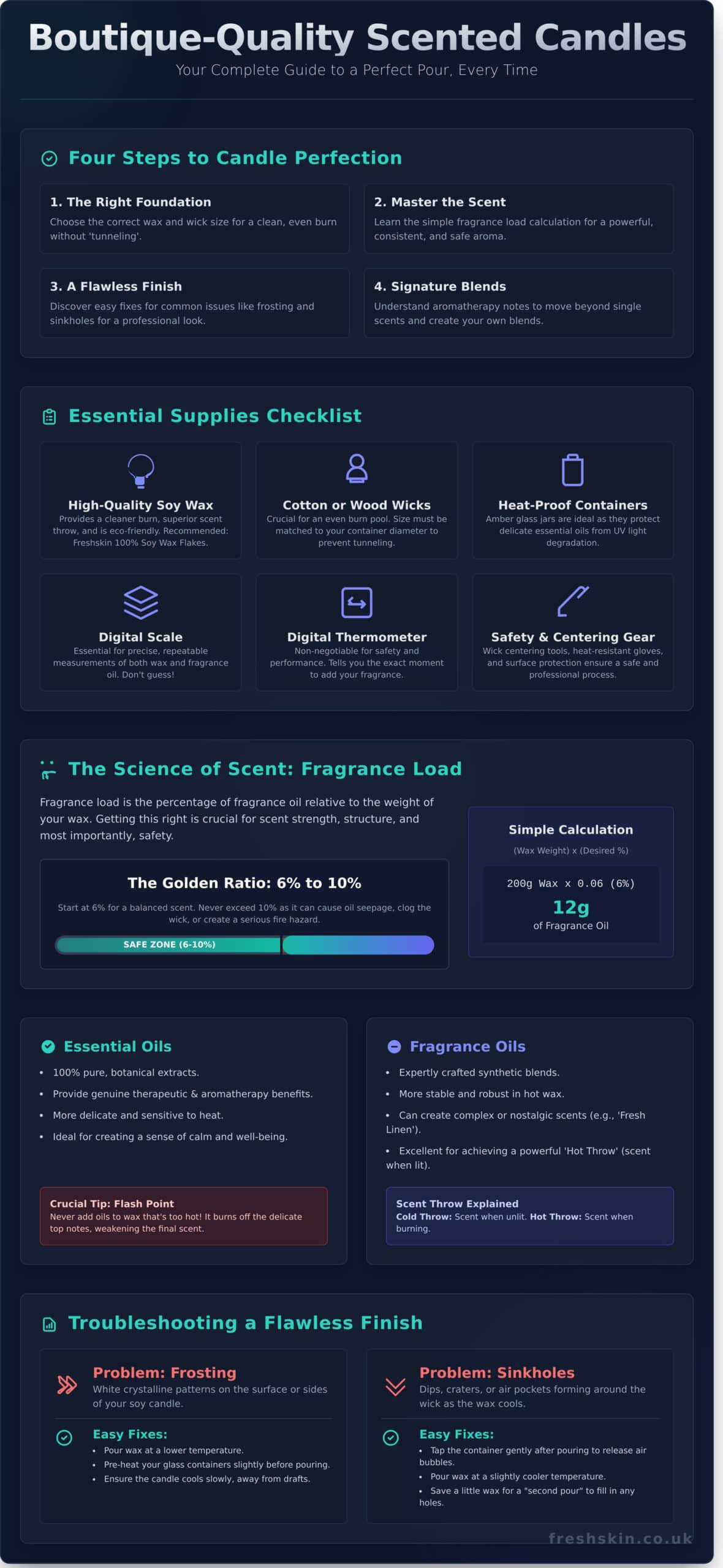
- High-Quality Soy Wax: Such as Freshskin 100% Pure Soy Wax Flakes.
- Cotton or Wood Wicks: Sized appropriately for your chosen jars.
- Heat-Proof Containers: Amber glass jars are an excellent, protective choice.
- Digital Scale: For precise, repeatable measurements of wax and fragrance oil.
- A Double Boiler or Bain-Marie: For melting wax gently and safely.
- Digital Thermometer: Crucial for monitoring wax temperature.
- Wick Centering Tools & Safety Gear: To ensure a professional finish and a safe workspace.
Mastering the Science: Fragrance Loads and Scent Ratios
Creating a beautifully scented candle is a delicate art, but it’s grounded in simple science. The key to a fragrant, safe, and long-lasting candle lies in understanding the relationship between wax and oil. This balance not only determines the strength of your candle’s aroma-both when it’s unlit (Cold Throw) and when it’s burning (Hot Throw)-but also ensures it burns correctly and safely. Getting this right is a fundamental part of learning how to make scented candles at home.
Calculating Your Scent Ratios
Fragrance load is the percentage of scent oil relative to the weight of the wax, typically kept between 6% and 10% for optimal safety and performance. We strongly recommend starting at 6% for your first few attempts and never exceeding the 10% maximum recommended by most wax suppliers. Too much oil won’t just make the scent stronger; it can compromise the candle’s structure, causing the oil to seep out and the wick to clog. In the worst-case scenario, this excess oil can become a fuel source, creating a significant fire hazard, a primary concern addressed by global candle fire safety standards.
To calculate the correct amount, simply multiply the weight of your wax by your desired fragrance load percentage:
- For a 6% load in a 200g candle: 200g x 0.06 = 12g of fragrance oil.
- For a 10% load in a 200g candle: 200g x 0.10 = 20g of fragrance oil.
Essential Oils vs. Fragrance Oils
The type of oil you choose also plays a crucial role. Our 100% pure, ethically sourced essential oils are perfect for creating candles with genuine therapeutic benefits, ideal for aromatherapy and promoting a sense of calm and well-being. However, they are more delicate than synthetic fragrance oils. Conversely, fragrance oils are expertly crafted blends designed for stability in wax and can produce more complex or nostalgic scents, like ‘Fresh Linen’ or ‘Baby Powder’, that are impossible to achieve with botanicals alone.
Always respect an oil’s flash point-the temperature at which its vapours can ignite. Adding any oil to wax that is too hot will cause the delicate top notes of the scent to burn off, leaving you with a weak or distorted fragrance. As a rule, add your chosen oil when the wax has cooled to around 85°C, stir gently but thoroughly for two minutes, and then pour.
Step-by-Step Guide: How to Pour the Perfect Scented Candle
This is the most therapeutic stage of the process, where liquid wax and pure fragrance become one. Before you begin, ensure your wicks are securely fixed to the bottom centre of your jars and give the glass a gentle pre-warm with a heat gun or in a low-temperature oven. This small step prevents the wax from cooling too quickly upon contact, ensuring a smooth, professional finish for your creation.
The Melting and Scenting Process
Using a double-boiler method (a pouring pot resting inside a larger saucepan of simmering water) provides gentle, consistent heat control, which is essential for protecting both the wax and your fragrance oils. Slowly melt your soy wax flakes until the liquid is completely clear, aiming for a temperature of 75-80°C. This ensures the wax molecules fully expand, making them ready to receive the fragrance.
Once melted, remove the wax from the heat and let it cool to 65°C. This is the sweet spot for adding your chosen Freshskin fragrance oil. Adding oil when the wax is too hot can cause the delicate top notes to evaporate. Pour in your oil and stir gently but continuously for a full two minutes. This critical step ensures the fragrance and wax bind on a molecular level; understanding the science of fragrance oils reveals how this bond creates a rich, consistent scent throw when your candle is lit.
The Perfect Pour and Cure
Patience is paramount for the perfect pour. Allow your scented wax to cool further to around 55°C. Pouring at this lower temperature is a key technique when learning how to make scented candles at home, as it minimises the risk of sinkholes and helps form a smooth, flat top. Pour slowly and steadily into your pre-warmed jars, leaving about 1cm of space at the top. Immediately use a wick centring tool to hold the wick perfectly upright as the wax begins to set.
Now for the final, and perhaps most important, ingredient: time. Your candle needs to cure. For soy wax, we recommend a curing period of one to two weeks in a cool, dark place. During this time, the crystalline structure of the wax fully forms around the fragrance oil, allowing them to bind completely. This patient process is the secret to a candle with a powerful, long-lasting aroma that beautifully fills a room.
Troubleshooting: Fixing Common Candle Making Mistakes
Even the most experienced artisan encounters a few hiccups. When you’re learning how to make scented candles at home, a lumpy top or a faint scent is a normal part of the creative process. Don’t be discouraged; these common issues are easily remedied with a little knowledge. Think of it as refining your craft, one beautiful, botanical candle at a time.
Fixing Surface Imperfections
A perfectly smooth, professional finish is achievable. If you notice bumps, craters, or white patches, here are our trusted solutions:
- Frosting & Bumpy Tops: Frosting, a white crystalline pattern, is a natural characteristic of pure soy wax. To minimise it, ensure your room is a stable, comfortable temperature, avoiding draughts. For a bumpy surface after cooling, a gentle wave of a hairdryer or heat gun a few inches from the surface will melt the top layer, leaving a beautifully smooth finish as it re-sets.
- Sinkholes: These small craters form when the wax cools too quickly, causing it to shrink and pull away from the centre. The best fix is a ‘top-off’ pour. Simply save a small amount of your scented wax and, once the candle is almost fully set, pour a final thin layer over the top to fill any imperfections.
- Wet Spots: These are not actually wet but are patches where the wax has pulled away from the glass. This is usually due to temperature fluctuations. To prevent this, try gently warming your glass jars before pouring and allow your candles to cool slowly and evenly, away from cold windowsills.
Improving Scent Throw
The ‘scent throw’ is the heart of a scented candle. If yours isn’t filling the room with fragrance, a few adjustments can make all the difference:
- Check Your Cure Time: This is the most common reason for a weak scent. Natural waxes need time for the fragrance molecules to bind fully. We recommend allowing your candles to ‘cure’ in a cool, dark place for at least one to two weeks before lighting for the most potent, therapeutic aroma.
- Fragrance Oil Temperature: Adding your essential oils when the wax is too hot can cause the delicate top notes to burn off. Always add your fragrance at the temperature recommended by your wax supplier, typically around 85°C, and stir gently but thoroughly for two minutes.
- Wick & Room Size: A smoking or sooting wick is often too long; always trim it to about 5mm before each burn. This ensures a clean, efficient flame that releases scent properly. Also, consider the room size-a small candle is perfect for a bathroom or study but won’t fill a large, open-plan living area.
Patience and practice are key. By understanding the science behind the wax and oils, you’ll soon be mastering the art of candle making. For the purest aromas, explore our range of 100% pure essential oils, ethically sourced for a truly luxurious experience.
Elevate Your Craft: Creating Signature Scent Blends
You have mastered the foundational steps of how to make scented candles at home; now, the true artistry begins. Creating a signature scent transforms your candle from a simple craft into a personal statement of comfort and style. Understanding the fundamentals of aromatherapy blending is the key to unlocking this potential and creating something truly unique.
Every balanced fragrance is built on three distinct layers, often called a scent pyramid:
- Top Notes: The initial, bright aroma you notice first. These are light and evaporate quickly, providing the first impression. Think citrus notes like Lemon or herbal scents like Peppermint.
- Middle Notes: The heart of the fragrance, which emerges as the top notes fade. These are typically well-rounded floral or herbal scents like Lavender and Rosemary that form the main body of the blend.
- Base Notes: The rich, deep scents that anchor the blend and linger the longest. Woody and resinous aromas like Sandalwood or Cedarwood provide depth and longevity.
For a beautifully simple and calming start, we recommend a classic blend of Lavender and Rosemary. As you grow in confidence, you can create scents for every season-from a crisp Fresh Linen for spring to a warm, inviting blend of Cinnamon and Clove for winter evenings. The quality of your creation is a direct reflection of your ingredients. As a UK-based, family-run business in Nottingham, we are committed to providing only 100% pure, ethically sourced oils. This promise ensures your candles have a clean burn and a true, therapeutic aroma.
Blending for Wellness
Harness the therapeutic properties of pure essential oils to enhance your space. Create a ‘Sleep Blend’ with calming Lavender and a soft hint of Sweet Almond oil for a deeply restful atmosphere. To invigorate your home and sharpen focus, a combination of clarifying Peppermint and Eucalyptus is wonderfully effective. We always recommend documenting your recipes-noting the exact number of drops or measurements-to ensure you can recreate your favourite blends with perfect consistency.
Next Steps: Labelling and Gifting
If you plan to gift or sell your beautiful creations, it is a legal requirement in the UK to include a CLP (Classification, Labelling and Packaging) compliant label. This important step ensures safety by clearly listing ingredients and any potential allergens. For an elegant and professional presentation, consider packaging your candles in our classic Amber Glass Jars, which also help protect the delicate fragrance oils from light degradation. Ready to find your signature scent? See our complete Fragrance Oils for Candle Making collection for inspiration.
Your Journey into Aromatic Candle Crafting Begins
You are now equipped with the essential knowledge to embark on your creative journey. From selecting the right foundational supplies and understanding the delicate science of fragrance loads to mastering the step-by-step pouring process and troubleshooting common issues, this guide has demystified how to make scented candles at home. You have the roadmap to create beautiful, fragrant candles with confidence.
The soul of a truly exceptional candle lies in the purity of its ingredients. As a family-run UK business based in Nottingham, we are passionate about providing the finest, ethically sourced botanical ingredients for your craft. Our 100% Pure Essential Oil Guarantee is our promise to you, ensuring every candle you make offers a clean, therapeutic, and authentic aroma. Start your candle making journey with Freshskin’s premium oils and waxes and discover the difference quality makes.
Embrace the calming ritual, let your creativity ignite, and enjoy the profound satisfaction of crafting something beautiful and uniquely yours.
Frequently Asked Questions About Making Scented Candles
Is it cheaper to make your own scented candles at home?
While there is an initial investment for equipment, which can be around £30-£50 for a starter kit, making your own candles is significantly more cost-effective over time. A luxury boutique candle in the UK can easily cost over £25. In contrast, the price per homemade candle can be as low as £3-£7, allowing you to enjoy high-quality, botanical scents for a fraction of the retail price while controlling the purity of every ingredient you use.
Which wax is best for making scented candles for beginners?
For those new to the craft, we wholeheartedly recommend using a pure soy wax. Its lower melting point makes it safer and more forgiving to work with than traditional paraffin wax. As a natural and renewable resource, soy wax is also beautifully simple to clean up using just soap and warm water. It holds fragrance exceptionally well and provides a clean, long-lasting burn, making it the perfect botanical base for your first creations and ensuring a rewarding experience.
Why does my homemade candle have no smell when burning?
A weak scent when burning, known as poor ‘hot throw’, is a common challenge when learning how to make scented candles at home. This is often caused by adding the fragrance oil when the wax is too hot, which can burn off the delicate aromatic notes. Other potential reasons include not using a high enough fragrance load for your specific wax type or not allowing the candle to cure for long enough. Curing is a vital step that allows the oil and wax to bind fully.
Can I use any essential oil for candle making?
While we champion the therapeutic benefits of pure essential oils, it is crucial to know that not all are suitable for candle making. Some oils have a low flash point, which can be a safety hazard in a lit candle, while others may not bind well with the wax, resulting in a poor scent. We advise using 100% pure essential oils or fragrance oils that have been specifically formulated and tested for candle safety and performance to ensure a stable, beautifully scented result.
How much fragrance oil do I need for 1kg of soy wax?
For a beautifully balanced and aromatic soy candle, the standard guideline is to use a fragrance load of 6% to 10% of the total wax weight. For 1 kilogram (1000g) of pure soy wax, this means you would need between 60g and 100g of your chosen fragrance oil. For a robust scent, we recommend starting with 8% (80g) and adjusting in future batches to achieve your desired intensity. Always measure your ingredients by weight for accuracy.
How long should I let my homemade candles cure before lighting?
Patience is an essential ingredient in creating the perfect candle. Curing is the vital period where the fragrance oil and wax molecules fully bind together. For natural soy wax candles, we recommend a minimum curing time of one to two weeks in a cool, dark place. This resting period allows the scent to mature and will provide a much stronger, more consistent aroma when you finally light your pure, homemade creation for a truly therapeutic experience.
Is it safe to make candles in a kitchen?
Yes, your kitchen can be a perfectly safe and suitable space for candle making, provided you follow key safety measures. Always protect your work surfaces, ensure the room is well-ventilated, and never leave melting wax unattended on the hob. It is vital to keep flammable materials, children, and pets away from your crafting area. Adhering to these simple precautions ensures a calm, safe, and enjoyable creative process from start to finish.
What is the best temperature to add fragrance oil to soy wax?
The temperature at which you add your fragrance oil is critical for achieving a beautiful and lasting scent. For most natural soy waxes, the ideal temperature is approximately 85°C (185°F). At this heat, the wax is perfectly molten to bond with the oil molecules, yet not so hot that it compromises the delicate top notes of your fragrance. After adding the oil, stir gently but thoroughly for two minutes to ensure it is fully incorporated before pouring.