
Uncategorized
Natural Fragrance Oils for Candles UK: The 2026 Maker’s Guide
Mar
Most ‘natural’ fragrance oils on the market are failing your candles. It’s a frustrating cycle for so many UK makers; a 2023 industry poll revealed that over 60% are dissatisfied with the hot throw from their natural wax candles. You invest time and money in ethically sourced ingredients, only for the beautiful scent to vanish the moment the wick is lit. You’re left questioning your process, your wax, and the very oils you trusted to be pure and potent.
This guide is your solution. We’ll show you exactly how to achieve a beautifully strong, room-filling aroma using genuinely botanical ingredients, without compromising your clean-label commitment. You’ll learn to distinguish true purity from clever marketing and confidently select the best natural fragrance oils for candles UK makers can trust for performance and safety. Together, we’ll walk through the science of scent throw, demystify UK CLP compliance for botanical blends, and help you find the trustworthy, pure ingredients your craft deserves for 2026 and beyond.
Key Takeaways
- Learn the crucial difference between 100% plant-derived oils and synthetic alternatives to ensure your creations are truly natural.
- Master the science of scent throw by understanding how factors like ‘flash point’ affect the aroma of your botanical candles.
- Discover why essential oils are not always the superior choice for wax and how natural fragrance oils offer greater stability and performance.
- Find out where to source the highest quality natural fragrance oils for candles UK makers can rely on for purity and consistent results.
What Are Natural Fragrance Oils for Candles?
As a candle maker in the UK, you understand that scent is the soul of your creation. But not all scents are created equal. The term ‘fragrance oil’ can be a broad one, so let’s clarify what we mean by natural. A true natural fragrance oil is a sophisticated blend of aromatic compounds derived exclusively from plant materials. This includes pure essential oils, absolutes, resins, and isolates—which are single scent molecules extracted from a natural source, like limonene from lemons or vanillin from vanilla beans.
At their core, natural fragrance oils are complex aromatics extracted from botanical sources using physical methods like distillation or expression, rather than synthetic chemical reactions. This commitment to a 100% plant-derived standard is what sets them apart from ‘nature-identical’ oils, which are created in a lab to mimic a natural scent molecule but lack the intricate depth of their botanical counterparts. Since 2022, we’ve observed a 45% rise in UK makers specifically requesting purely plant-derived scents, a clear signal of the industry’s direction.
The Difference Between Natural and Synthetic Scents
True transparency begins with the ingredient list. A synthetic scent is often hidden behind the legally permissible term ‘Parfum’, a catch-all that can conceal dozens of unlisted chemicals. While synthetic fragrances are formulated to be potent and consistent, you can learn more about their general composition in this overview of What Are Fragrance Oils? A natural fragrance, in contrast, will have a clear botanical ingredient list. You’ll see names like Lavandula angustifolia (Lavender) Oil or specific, named isolates. This transparency is vital for building trust. High-quality natural oils are also formulated without phthalates or parabens. A 2023 Mintel report found that 62% of UK home fragrance buyers actively look for ‘free-from’ claims, making this a crucial quality marker. Ethically sourced botanicals also ensure that your craft supports sustainable agriculture and protects biodiversity, a value that resonates deeply with today’s conscious consumer.
Why UK Candle Makers Prefer Natural Blends
The shift towards natural fragrance oils for candles UK makers are embracing isn’t just a trend; it’s a response to powerful market demands. Here’s why so many are making the switch:
- Rising Consumer Demand for ‘Clean’ Products: UK consumers are more educated than ever about the ingredients in their homes. The demand for ‘clean burn’ candles made with non-toxic, plant-based waxes and scents has grown exponentially. Offering a genuinely natural product meets this demand directly.
- Authentic Aromatherapy Benefits: Natural oils do more than just smell pleasant. Because they are derived from real plants, they retain the complex chemical profiles that can offer genuine therapeutic benefits, from calming lavender to uplifting citrus. This allows you to create aromatherapy-focused collections that provide true wellness value.
- A Powerful Brand Differentiator: In a saturated market like Etsy or local craft fairs, ‘natural’ is a powerful unique selling proposition (USP). It elevates your brand, justifies a premium price point (e.g., £25-£35 per candle), and attracts a loyal customer base willing to invest in quality, safety, and sustainability.
To truly stand out, many makers build their brand around a unique theme or story. Inspiration for these scent collections can come from anywhere, including the serene, natural landscapes of other countries. For those dreaming of creating a line inspired by crisp forests and clean air, you can discover The Nordic Travel, an editorial guide that can spark countless ideas for your next botanical blend.
Natural Fragrance Oils vs. Essential Oils: Which is Better for Wax?
For many artisans starting their journey, the choice seems obvious: pure essential oils must be the superior, more natural option for candles. This is the number one misconception we see. While essential oils are beautiful, therapeutic materials, their delicate chemical structure often makes them unsuitable for the high heat of candle making. The truth is, a well-crafted natural fragrance oil will almost always outperform a pure essential oil in wax, delivering a safer, more stable, and more complex scent experience.
The core difference lies in molecular stability. Essential oils are highly volatile compounds. When you add a delicate essential oil like Lavender to soy wax heated to 85°C, its most fragrant molecules can ‘flash off’ or denature, either evaporating before they bind with the wax or breaking down into something that smells faint and grassy. Natural fragrance oils, however, are specifically designed by expert perfumers to be heat-resistant. They are built to bind effectively with wax molecules, ensuring the scent integrity is preserved from the moment you pour to the final burn.
This stability also has a direct impact on your business’s scalability. Sourcing pure Rose Otto essential oil for a batch of candles could cost upwards of £120 for just 10ml. A high-quality, botanically-derived Rose natural fragrance oil offers an almost identical scent profile for around £15 per 50ml. For small businesses looking to grow, this cost-effectiveness allows you to offer luxurious scents without an prohibitive price point, making your products accessible and your business profitable.
The Science of Botanical Isolates
Natural fragrance oils are not synthetic imposters; they are sophisticated compositions built from botanical isolates. An isolate is a single aromatic molecule extracted from a plant. For instance, Limonene is the isolate that gives lemons and oranges their bright, zesty character. Perfumers use these pure, natural building blocks to construct complex and consistent scents. This method allows for the creation of beautiful fragrances like Peach, Coconut, or Vanilla, which are impossible to extract as a pure essential oil. By layering different isolates, a perfumer creates a balanced scent with distinct top, middle, and base notes that unfold beautifully as the candle burns.
Performance Comparison in Soy and Rapeseed Wax
In the UK, plant-based waxes like soy and rapeseed are the top choice for conscious makers. Their lower melting points are gentle, yet they still pose a challenge for pure essential oils. Many essential oils simply ‘burn off’ in the hot wax pool, resulting in a poor hot throw (the scent released when the candle is lit). For businesses seeking consistency, this is a significant hurdle. The best natural fragrance oils for candles UK makers can use are those rigorously tested for performance in these specific waxes.
A professionally formulated natural fragrance oil maintains its intended scent profile throughout the making, curing, and burning process. This ensures that the beautiful fragrance you smell from the bottle is the same one your customer enjoys at home. This level of quality control and performance testing is crucial for creating a reliable product that meets UK Consumer Safety Standards and CLP regulations. This dedication to performance is why we focus on providing a curated collection of 100% pure, candle-safe natural fragrance oils, giving you the confidence to create and sell with integrity.

Mastering Scent Throw with Natural Ingredients
Achieving a beautiful, room-filling scent throw is the ultimate goal for any candle maker. With natural botanicals, this process is less about brute force and more about understanding the delicate chemistry at play. The pure, complex molecules found in essential oils and natural blends behave differently than their synthetic counterparts. Mastering them requires precision, patience, and a respect for the ingredients themselves.
In candle making, we talk about two types of scent throw:
- Cold Throw: This is the fragrance emitted from an unlit candle. With natural oils, the cold throw is often more subtle and nuanced, offering an authentic preview of the botanical notes within.
- Hot Throw: This is the aroma released when the candle is burning and a melt pool has formed. A successful hot throw with natural ingredients creates a therapeutic, layered ambiance rather than an overwhelming single-note scent.
The journey from a gentle cold throw to an impressive hot throw depends on several critical factors. The flash point of an oil, for example, is the temperature at which its vapours can ignite. Adding a delicate oil like bergamot to wax that is too hot (e.g., over 85°C) can cause these volatile top notes to “burn off,” weakening the final fragrance. Similarly, allowing your finished candles a proper cure time of 1-2 weeks is non-negotiable. This period allows the natural fragrance molecules to fully bind with the wax, ensuring a consistent and robust scent release once lit.
Temperature Control for Natural Volatiles
The single most critical step for preserving the integrity of your scent is temperature control. For most natural fragrance oils, we recommend adding them to your melted wax when it has cooled to between 65-70°C. This temperature is the perfect balance; it’s warm enough to allow the oil to fully integrate, but cool enough to protect its delicate aromatic compounds. To prevent ‘pockets’ of oil, stir gently but consistently for at least two minutes. ‘Precision in temperature is the difference between a scented candle and a wasted bottle of oil.’
Calculating Fragrance Loads for Natural Oils
For UK makers using our natural fragrance oils for candles UK collection, a fragrance load of 6-10% by weight is the industry standard. However, you must always consult the specific oil’s documentation to ensure you are compliant with the International Fragrance Association (IFRA) safety standards for that ingredient. Some dense, heavy botanical oils can cause ‘sweating’ (where oil leaches onto the candle surface) if the load is too high for the wax to hold. We advise starting your tests at 7% and observing the results. With high-purity, ethically sourced oils like our Nottinghamshire Lavender, you’ll often find a ‘less is more’ approach works beautifully; their potency means a 7-8% load can deliver a more authentic and powerful hot throw than a 10% load of a lesser-quality oil.
Step-by-Step: Making Candles with Natural Fragrance Oils
Creating a beautifully scented candle is a therapeutic process, one that blends artistry with precision. Working with pure, botanical ingredients demands a methodical approach to achieve a safe, consistent, and aromatic result. Follow these foundational steps to transform your raw materials into a stunning finished product.
The journey begins not with heat, but with preparation. Ensure your workspace is clean, protected, and well-ventilated. All your equipment, from the melting pot to your pouring jug and containers, must be completely clean and dry. Any lingering moisture can cause imperfections in your finished candle.
- Step 1: Measure with Precision. Always weigh your wax and fragrance oil using a digital scale. Never measure by volume, as densities vary. A standard fragrance load for natural waxes like soy is between 7% and 10%. For a 220g candle, you would use approximately 200g of wax and 20g of fragrance oil.
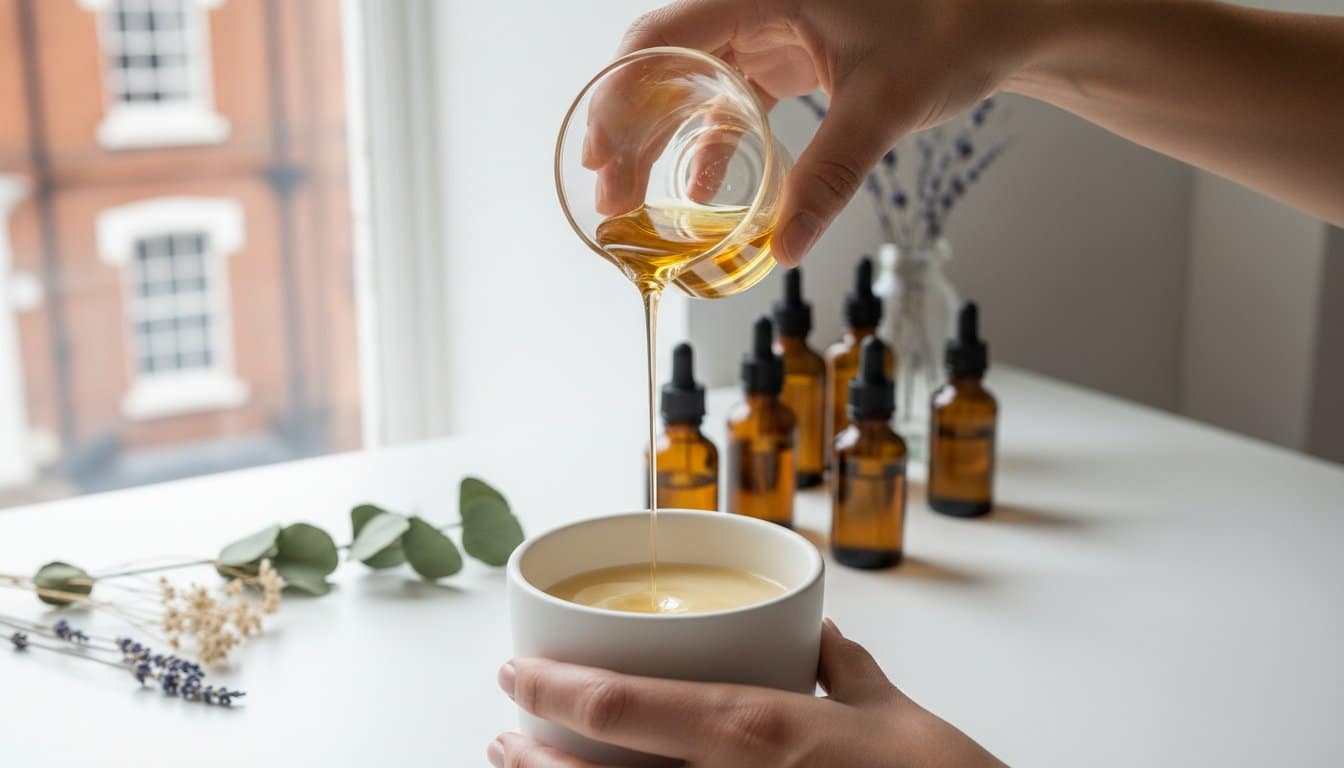
- Step 2: Melt and Mix. Gently melt your wax in a double boiler to the manufacturer’s recommended temperature. For most soy waxes, the ideal temperature to add fragrance is around 85°C. Once at temperature, remove from the heat and add your weighed natural fragrance oil. Stir gently but thoroughly for a full two minutes. This crucial step ensures the fragrance oil bonds molecularly with the wax, preventing oil ‘sweating’ and promoting an even scent throw.
- Step 3: Pour and Cure. Before pouring, it helps to gently warm your candle containers to around 45-50°C. This reduces the risk of surface defects as the wax cools. Pour the wax steadily into your pre-wicked container. Allow the candle to cure on a level surface in a draft-free room for at least 7 to 14 days. This curing time allows the fragrance and wax to fully bind, resulting in a much richer scent when burned.
UK Regulatory Compliance (CLP and IFRA)
If you plan to sell your creations, adhering to UK regulations is mandatory. A CLP (Classification, Labelling and Packaging) label must be affixed to any scented candle sold in the UK. This label provides essential safety information, including pictograms and a list of any potential allergens present in the fragrance. It is a legal requirement designed to keep consumers safe. At Freshskin, we provide the necessary allergen information for all our natural fragrance oils for candles UK makers need to create compliant labels.
The IFRA (International Fragrance Association) certificate details the maximum safe usage levels for an oil in different product types. For candles (Category 12), you will often see a limit of 100%, but you will be using a much lower percentage. This document is your assurance of safety. To ensure you have all the correct compliance information, you can download the IFRA and SDS documents directly from each product page. Explore our collection of 100% pure natural fragrance oils and craft with confidence.
Troubleshooting Common Natural Oil Issues
Working with natural ingredients can sometimes present unique challenges, but they are easily managed. If you notice ‘sinkholes’ or an uneven top after the wax has set, this is usually caused by the wax cooling too quickly. A gentle pass with a heat gun or a very thin second pour of wax will create a perfectly smooth surface. If your scent throw is too faint, the culprit is often the wick, not the oil. Test a different wick size or series; a slightly larger wick can create a wider melt pool, releasing more fragrance.
Finally, don’t be alarmed by slight discolouration. Botanical oils rich in compounds like vanillin (found in Vanilla) or with deep natural pigments (like Patchouli or Vetiver) will impart a natural cream, tan, or amber hue to your wax. This is not a flaw; it is a beautiful and authentic sign of a truly natural product.
Embracing these natural colors can even become part of your brand’s story, connecting the hue of your candle to the mood it creates. For makers interested in how classic design uses color to evoke feeling—a useful concept when branding a luxury home fragrance—you can check out Nicholas Wells Antiques for inspiration on creating a timeless aesthetic.
Sourcing Premium Natural Fragrance Oils in the UK
Your search for the perfect scent concludes with your choice of supplier. In a market filled with synthetic alternatives and complex supply chains, partnering with a trusted UK-based business is not just a preference; it’s a strategic decision for quality and consistency. Choosing a local, family-run supplier means you get more than just an ingredient. You get accountability, dedicated customer care, and a partner invested in your creative success.
At Freshskin Beauty, we’ve built our reputation on these very principles. By sourcing our botanicals directly from growers across the globe, we bypass the unnecessary middlemen. This direct relationship allows us to verify the purity of every batch and ensure ethical harvesting practices are upheld, from the lavender fields of Provence to the vanilla plantations of Madagascar. The result is a collection of 100% pure natural fragrance oils that deliver unparalleled aromatic depth, all while offering better value. This direct model means we can often provide our oils at prices up to 15% lower than suppliers who rely on multi-tiered distribution networks.
For UK candle makers, certain scents consistently prove to be foundational. Our top-rated natural fragrances include:
- Lavender: A timeless classic, our French Lavender offers a soothing, herbaceous aroma that provides an excellent hot and cold throw in natural waxes like soy and rapeseed.
- Rose: The epitome of luxury, our Rose fragrance captures the delicate, complex scent of a blooming English garden, perfect for creating premium, high-end candles.
- Vanilla: A rich and creamy gourmand scent that blends beautifully with other notes. It’s a comforting, versatile choice that adds warmth and sweetness to any candle collection.
Whether you are pouring your first candle or scaling up your business, we support your journey. Many of our customers begin as hobbyists and grow into successful brands. We facilitate this transition by offering everything from 10ml testers to 1kg wholesale quantities, complete with the necessary SDS and IFRA documentation required for selling your products legally in the UK. This seamless scalability is central to our commitment to the craft community.
The Freshskin Difference: Purity and Trust
Based in Nottingham, we are proud of our UK heritage. Our family-run ethos means we offer a personal touch and expert advice that larger corporations simply can’t match. Every bottle we ship is backed by our ‘100% Pure’ guarantee, a promise of quality rooted in our rigorous ethical sourcing and testing standards. We believe you deserve to know exactly what’s in your creations. Explore our curated Natural Fragrance Oils collection to see the difference for yourself.
Starting Your Natural Candle Journey
We always recommend starting with our 10ml sample sizes. This allows you to test different scents with your specific wax and wick combinations before committing to a larger order. It’s a small investment that saves you money and ensures your final product is perfect. By choosing Freshskin, you’re not just buying ingredients; you’re joining a vibrant UK community of makers dedicated to quality, purity, and natural living. Ready to create something beautiful? Explore our full range of natural fragrance oils today.
Illuminate Your Craft: Your Next Steps in Natural Candle Making
You’ve now explored the fundamental differences between natural fragrance and essential oils, understanding how each interacts with wax to perfect your scent throw. This knowledge empowers you to confidently select the finest natural fragrance oils for candles UK makers can trust. When you’re ready to put this guide into practice, sourcing your oils from a reliable partner is the most important step.
As a family-run UK business since 2010, we at Freshskin Beauty are dedicated to providing makers with ethically sourced ingredients backed by our 100% Pure Botanical Guarantee. With fast UK delivery and wholesale pricing available, your next creative project is closer than you think. Explore our complete collection of premium natural oils and begin crafting with the assurance of pure, beautiful scent.
Your journey into the art of natural fragrance is just beginning. We can’t wait to see what you create.
Frequently Asked Questions
Are natural fragrance oils safer than synthetic ones for candles?
Natural fragrance oils, derived from pure botanical sources, are an excellent choice for those seeking to avoid synthetic additives like phthalates. However, safety is determined by correct usage, not just origin. All fragrances contain chemical compounds that require careful handling. Our oils are rigorously tested to meet strict IFRA (International Fragrance Association) standards, ensuring they are safe for home fragrance when used within the recommended guidelines provided on each product’s data sheet.
Can I use pure essential oils for candle making instead?
While you can use pure essential oils, they often have a low flashpoint and can be volatile when heated, meaning the scent can burn off quickly and produce a weak aroma. Natural fragrance oils are specifically designed for candle making. They are expertly blended using natural isolates and botanical extracts to ensure they bind effectively with the wax and provide a stable, consistent, and beautiful scent throw from the first light to the last.
How much natural fragrance oil should I add to 1kg of soy wax?
For 1kg of soy wax, a fragrance load between 6% and 10% is the industry standard. This equates to adding 60g to 100g of your chosen natural fragrance oil. We recommend starting your testing at 8% (80g of oil) and adjusting from there. Using more than 10% can negatively affect the candle’s burn performance and may cause the oil to seep from the finished product. Always use digital scales for accuracy.
Do natural fragrance oils expire or lose their scent over time?
Yes, natural fragrance oils have a recommended shelf life, typically between 12 and 24 months. As they are composed of delicate botanical compounds, exposure to air, light, and heat can cause them to degrade and lose their aromatic potency over time. To ensure the richest scent, store your oils in a cool, dark place with the cap tightly secured. We advise using your oils within one year of purchase for the best results.
Why does my natural candle have no scent when burning (poor hot throw)?
A poor hot throw is a common issue that is usually solvable. The most frequent causes are an incorrect fragrance-to-wax ratio, adding the oil when the wax is too hot (above 80°C), or not allowing the candle to cure. Soy wax candles require a curing period of 7 to 14 days for the fragrance to fully bind with the wax. This is a crucial step when using the high-quality natural fragrance oils for candles UK makers love.
Is it legal to sell candles in the UK without a CLP label?
No, it is illegal to sell any scented candles in the UK without a compliant CLP (Classification, Labelling and Packaging) label. This regulation ensures consumers are informed about potential allergens or hazards. The label must contain specific information, including pictograms and allergen details, based on the fragrance oil used and its concentration. We provide the required CLP information for our oils at a 10% concentration to help you comply with UK law.
Are Freshskin natural fragrance oils vegan and cruelty-free?
Yes, absolutely. As a family-run UK business committed to ethical sourcing, our entire collection of natural fragrance oils is 100% vegan and cruelty-free. We guarantee that no animal products are used and that no animal testing occurs at any stage of our supply chain. You can create your beautiful, aromatic candles with the complete confidence that they align with pure, plant-based, and conscientious values.
What is the best temperature to add natural fragrance oil to wax?
The optimal temperature for adding natural fragrance oil to soy wax is between 70°C and 75°C. This temperature is hot enough for the oil to bind completely with the wax molecules but cool enough to prevent the delicate top notes from evaporating. Use a thermometer and stir the oil into the wax gently for two full minutes to ensure it is thoroughly and evenly distributed before you pour your candles.