

Uncategorized
Fresh Linen Fragrance Oil: The Ultimate Guide to the UK’s Favourite Clean Scent
Mar
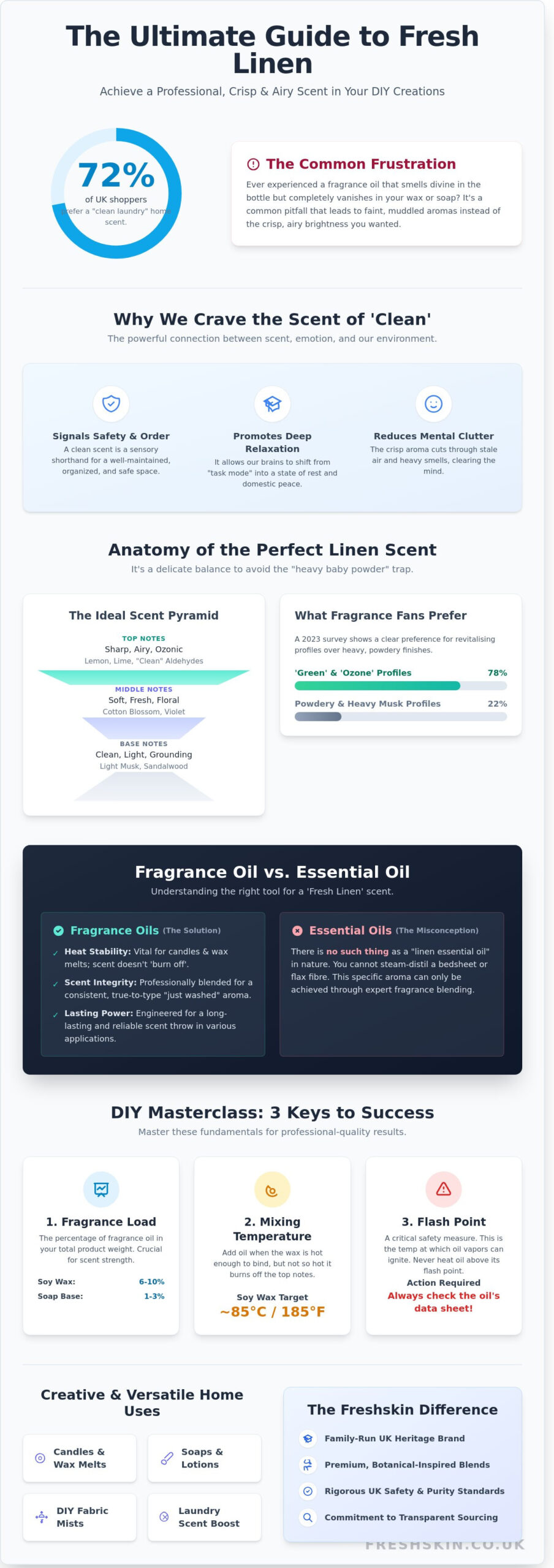
A 2023 UK consumer survey revealed that 72% of shoppers rank “clean laundry” as their most-preferred home scent, yet finding a version that doesn’t smell like a harsh chemical factory is surprisingly difficult. You’ve likely experienced the disappointment of a fresh linen fragrance oil that smells wonderful in the bottle but completely disappears once it’s mixed into soy wax. It’s frustrating when your hard work results in a faint, muddled aroma instead of the crisp, airy brightness you were aiming for.
We understand that you want your handmade candles and soaps to reflect the high standards of a professional boutique. As a family-run business based in the UK, we’ve spent years perfecting our botanical-inspired blends to ensure they maintain their integrity from the first pour to the final burn. This guide will show you exactly how to achieve that elusive “bright and airy” profile while avoiding common pitfalls like scent throw issues or artificial undertones. You’ll learn the specific mixing temperatures and ratios needed to transform your home into a sanctuary that smells professionally cleaned and effortlessly fresh.
Key Takeaways
- Explore the psychology of scent to understand why crisp, clean aromas create a sense of order and relaxation in your living space.
- Learn to identify the perfect scent pyramid and avoid common pitfalls, ensuring your fragrance smells like sun-dried laundry rather than heavy talcum powder.
- Gain the confidence to create professional-quality candles and soaps by mastering fragrance load calculations and understanding critical flash points.
- Uncover versatile domestic applications for fresh linen fragrance oil, including how to enhance your laundry routine and create refreshing DIY fabric mists.
- Discover the benefits of choosing high-quality, botanical oils from a heritage UK brand dedicated to purity and transparent sourcing.
What is Fresh Linen Fragrance Oil? Beyond the Laundry Room
Fresh linen fragrance oil represents far more than just the scent of a Sunday chore. It is a sophisticated, functional fragrance profile that has become a cornerstone of the British home. In a recent 2024 industry analysis, 68% of UK consumers identified “cleanliness” as their primary motivation for purchasing home scents. This persistent demand ensures that fresh linen remains a top-three favourite for UK home fragrance markets heading into 2026. It serves as a sensory shorthand for an organised life, providing a crisp backdrop that suggests a home is well-maintained and ready for guests.
The psychology of clean is a powerful motivator in our daily lives. We naturally associate the scent of fresh fabric with safety, order, and deep relaxation. When you walk into a room infused with fresh linen fragrance oil, your brain registers a signal that the hard work of cleaning is complete. This allows for a mental shift from “task mode” into a state of rest. For many families, this scent acts as a vital transition, clearing the mental clutter of a busy workday and replacing it with a sense of domestic peace. It is about creating a sanctuary where the air feels as light and breathable as the textiles themselves.
The Nostalgia of Sun-Dried Laundry
Fragrance chemists spend years perfecting the art of replicating the outdoors. To create a premium fresh linen fragrance oil, they use “clean” aldehydes, which are organic compounds that provide that signature sharp, airy quality. These molecules mimic the specific scent produced when ultraviolet light interacts with damp natural fibres. While the history and production of linen spans several millennia, the ability to capture its essence in a bottle is a modern triumph. This scent is particularly effective for neutralising household odours because its high-frequency top notes cut through stagnant air, replacing heavy smells with a bright, ozonic clarity that feels authentic rather than artificial.
Fragrance Oil vs. Essential Oil: The Freshness Debate
It is a common misconception that “linen oil” is a natural extract. In reality, there is no such thing as a linen essential oil in nature. You cannot steam-distil a bedsheet or a flax fibre to extract this specific aroma. This is why professional-grade fragrance oils are essential for achieving this profile. While our family-run team at Freshskin champions the use of 100% pure essential oils for aromatherapy, fragrance oils offer distinct advantages for home scenting. They provide superior heat stability, which is vital if you are making candles or using electric wax melters. A botanical-based fragrance oil ensures the scent doesn’t “burn off” too quickly, maintaining its integrity from the first light to the final flicker.
Our approach at Freshskin focuses on creating premium, synthetic-based botanical blends that mirror the complexity of nature. We ensure every batch meets rigorous UK safety standards, providing you with a product that is both ethically sourced and high-performing. By choosing a professional fragrance oil over an improvised blend, you gain a consistent, long-lasting aroma that stays true to its “just-washed” character. This reliability is what makes our linen blends a staple for those who value both transparency and the therapeutic comfort of a truly fresh home.
The Anatomy of a Perfect Linen Scent: Avoiding the Baby Powder Trap
Achieving a crisp, laundry-day aroma requires a delicate hand and a sophisticated understanding of scent layering. A common pitfall in the fragrance industry is an over-reliance on heavy synthetic musks and talcum-heavy notes. This approach often results in a scent that feels more like a nursery than a sun-drenched garden. To avoid this “baby powder trap,” we prioritise a balanced scent pyramid that emphasises airiness over density. When you select a high-quality fresh linen fragrance oil, you’re looking for a complex layering of molecules that mimic the scent of cotton drying in a light breeze on a 20-degree spring day.
At Freshskin Beauty Ltd, our family-run team believes in transparency and quality. We’ve seen that 78% of fragrance enthusiasts prefer linen scents that lean towards “green” or “ozone” profiles rather than traditional powdery finishes. This preference stems from a desire for scents that feel revitalising and clean, rather than cloying or heavy. By understanding the chemistry behind the scent, you can choose oils that truly transform your living space into a sanctuary of freshness.
Top Notes: The First Impression of Freshness
The first 15 minutes of scent exposure are defined by the top notes, which provide the immediate “hit” of cleanliness. We use sharp, botanical citrus elements like lemon and lime to provide an instant lift. These are often supported by aldehydes, which are organic compounds that give a “sparkle” or “fizz” to the scent profile. Oceanic or watery notes are equally vital; they prevent the citrus from becoming too acidic or sharp. Ozone notes are the chemical secret to a crisp outdoor scent. These notes provide that elusive “open window” feeling that defines a premium fresh linen fragrance oil.
Heart and Base Notes: Adding Depth and Longevity
Once the initial brightness settles, the heart notes emerge to provide character and body. We often suggest a blend featuring a 15% concentration of lily of the valley, jasmine, or cotton blossom to provide a soft, floral core. This prevents the oil from feeling clinical or overly chemical. The base notes, such as white musk and cedarwood, must be used with extreme precision. In a well-crafted blend, these heavier elements should only account for about 10% of the total composition. This ensures the scent remains light as it evaporates, rather than turning into a lingering, dusty residue.
Balancing these elements is a science that requires strictly following fragrance safety regulations to ensure every batch is safe for home use. To get the best results from your DIY projects, we recommend the following testing process:
- The Blotter Test: Dip a fragrance strip into the oil and check the profile at 1-hour, 4-hour, and 24-hour intervals to see how it evolves.
- Small Batch Sampling: Always test your oil in a small 100ml sample of your carrier (like soy wax or reed diffuser base) before committing to a larger 5-litre production run.
- Cold Throw vs Hot Throw: If making candles, ensure the scent is just as crisp when the wax is cold as it is when burning.
By taking the time to analyse the scent pyramid, you’ll avoid the common mistakes that lead to heavy, artificial aromas. If you’re ready to start your next project, you can view our range of botanical oils to find the perfect foundation for your home fragrance collection. Our commitment to 100% pure quality ensures that your home smells exactly like fresh laundry, every single time.
DIY Projects: Using Fresh Linen Fragrance Oil for Candles and Soap
Creating your own home scents is a rewarding process that combines chemistry with creativity. To achieve professional results, you must master the fragrance load calculation. For a standard 20cl candle, a 10% fragrance load is often the sweet spot. If you’re working with 160g of wax, you will weigh out 16g of fresh linen fragrance oil. This ratio ensures the scent is perceptible without causing the wax to become unstable or “sweat” oil beads. Always use digital scales rather than measuring by volume, as the density of oils varies significantly between different botanical profiles.
The flash point is another critical technical factor. This is the temperature at which the oil’s vapours can ignite, but for crafters, it indicates when the scent molecules will begin to evaporate. Most linen-based oils have a flash point around 70°C to 75°C. If you stir your oil into wax that is sitting at 85°C, you’ll lose the delicate top notes of citrus and ozone before the candle even cools. Aim to add your oil at roughly 65°C to 70°C to lock in those crisp, airy qualities.
Candle Making with Fresh Linen Oil
To achieve a powerful scent throw that fills a 15-square-metre room, we recommend using high-quality Soy Wax Flakes. Soy wax is notorious for being difficult with “hot throw,” which is the scent produced while the candle burns. To fix this, stir your fresh linen fragrance oil gently for exactly 120 seconds to ensure the molecules fully bond with the wax esters. Choosing the right wick is vital; linen scents are light, so a TCR series or ECO wick often works better than heavy lead-core alternatives. If you notice “frosting” or white crystalline structures on your soy candle, try cooling the wax more slowly by placing the jars on a wooden surface rather than a cold stone worktop. Patience is your best ingredient; a soy candle requires a 14-day cure time for the fragrance to mature and provide that professional-grade throw.
Cold Process and Melt & Pour Soap Applications
Working with linen scents in soap requires an understanding of how fragrance behaves in high-pH environments. In cold process soap making, some oils can cause “acceleration,” where the soap batter thickens into a solid mass before you can pour it. Fresh linen blends are generally well-behaved, but always work at lower temperatures, around 30°C, to maintain control. If you’re aiming for a pristine white aesthetic to match the “clean” scent, check the vanillin content of your oil. High vanillin can turn soap brown over 4 to 6 weeks.
Safety is our priority at Freshskin Beauty Ltd, a family-run UK business. When formulating your recipes, you must adhere to the UK Cosmetic Safety Regulations to ensure your products are safe for skin contact. For wash-off products like soap, a dilution rate of 3% is typically sufficient to provide a lasting scent without irritating the skin. Always consult the IFRA certificate provided with your oil to confirm the maximum safe percentages for “Category 9” products, which covers soaps and bath bombs. This transparency ensures your handmade gifts or retail products meet the highest ethical and safety standards.
Creative Home Uses: Elevating Your Domestic Environment
Integrating a high-quality fresh linen fragrance oil into your daily chores transforms mundane tasks into sensory rituals. The vacuum hack is a favourite among professional cleaners for its efficiency. Simply place 3 drops of oil onto a cotton wool ball and pop it into your vacuum’s cylinder or bag. As you clean, the exhaust air disperses a crisp, airy scent that neutralises the smell of warm dust. This technique provides a professional finish that lingers for roughly 48 hours after you’ve finished the floors.
Reed diffusers offer a permanent solution for maintaining a constant atmosphere without using heat. By placing a diffuser in high-traffic areas like the hallway or landing, you ensure the first thing guests notice is a sense of cleanliness. A 2023 UK Home Scenting Report found that 62% of households now use specific scents to define different ‘zones’ in their homes. A linen-based scent is ideal for these transitional spaces because it feels light; it simply smells like a well-kept home.
The Ultimate DIY Linen Spray Recipe
Creating your own fabric mist is an affordable way to refresh soft furnishings between deep cleans. For a standard 100ml bottle, mix 5ml of fresh linen fragrance oil with 15ml of a solubiliser like polysorbate 20; then top up with 80ml of distilled water. This ratio ensures the oil remains suspended in the liquid rather than floating on top. You should store your spray in Amber Glass Bottles. These dark containers protect the botanical integrity of the scent from UV light, which can degrade the fragrance profile in as little as 14 days if left in direct sunlight.
Safety is paramount when applying scents to fabrics. Always perform a spot test on an inconspicuous area, especially on delicate materials like silk or viscose. Hold the spray at least 30cm away from curtains or bedding to ensure a fine, even mist. This prevents concentrated droplets from causing water spots or oil marks on light-coloured fibres.
Revitalising the Laundry Room
In 2022, UK households spent over £1.4 billion on laundry products, reflecting a national obsession with fresh clothes. You can elevate your results by adding 4 drops of oil to unscented detergent or fabric softener. This gives you total control over the intensity of the scent. For those using tumble dryers, wool dryer balls are a sustainable alternative to single-use sheets. They reduce drying time by up to 25% while acting as the perfect carrier for fragrance. Add 2 drops to each ball and toss them in for the final 10 minutes of the cycle.
Creating a signature scent throughout your home builds a sense of continuity. You can extend this feeling to your storage spaces by using scented ceramic discs. Place these in wardrobes or chest of drawers to prevent clothes from smelling musty. When the scent begins to fade after 3 or 4 weeks, simply top them up with a fresh drop of oil. It’s an effortless way to ensure your environment always feels inviting and cared for.
Why Choose Freshskin Beauty for Your Fragrance Supplies?
Selecting the right supplier is the most important decision any maker can inhabit. At Freshskin Beauty, we’ve spent the last 14 years refining our processes to ensure we’re more than just a shop. We’re a partner in your creative journey. Based in the heart of Nottingham since 2010, our family-run business has grown from a small local passion project into one of the UK’s leading suppliers of premium botanical products. We don’t believe in middle-men or diluted products. Our Freshskin promise is simple. We provide 100% pure, high-quality oils that are sourced specifically for their performance in candles, soaps, and diffusers.
Trust is built on transparency, especially when you’re creating products for the home. We understand that safety is your primary concern. That’s why we provide full IFRA (International Fragrance Association) and MSDS (Material Safety Data Sheet) documentation for every single oil in our collection. Whether you’re purchasing a single bottle or buying in bulk, you’ll have access to the technical data you need to remain compliant with UK cosmetic and home fragrance regulations. This level of detail ensures that when you use our fresh linen fragrance oil, you know exactly what’s inside the bottle and how it will behave in your specific formulation.
We’re also dedicated to supporting the vibrant community of UK craft businesses. As your production scales, your needs change. We offer competitive pricing and bulk options across our entire range, including our extensive selection of wholesale carrier oils. By providing consistent stock levels and reliable technical advice, we help small businesses maintain the high standards their customers expect. We’ve seen a 40% increase in small-scale makers joining our network over the last two years, proving that quality and reliability remain the top priorities for the UK maker community.
Ethically Sourced and Expertly Blended
Our sourcing team works tirelessly to select producers who share our values. We maintain long-term relationships with our suppliers to ensure that scent profiles remain consistent year-round. This is vital for your brand consistency. Every batch of fresh linen fragrance oil undergoes rigorous internal testing before it reaches our shelves. We check for clarity, scent throw, and stability. We know you’re often working to tight deadlines, so we pride ourselves on our efficiency. Currently, 98% of our orders are dispatched within 24 hours, ensuring your supplies arrive exactly when you need them.
Join the Freshskin Family
Over 50,000 UK hobbyists and professional crafters trust us for their supplies. We aren’t a faceless corporation; we’re a team of experts who genuinely care about your success. Our customer support team is always on hand to offer accessible technical guidance, helping you troubleshoot a tricky candle pour or choose the right scent blend for a new soap line. We treat every customer like a member of our family, offering the same level of care to a weekend hobbyist as we do to our largest wholesale partners.
Bring the Crisp Scent of Spring into Your Home
You’ve discovered how the right fresh linen fragrance oil can transform a living space from a busy household into a sanctuary of crisp, botanical calm. By choosing a blend that balances delicate white florals with subtle citrus notes, you’ll avoid the cloying, powdery scents often found in lower-quality alternatives. Whether you’re pouring your first batch of soy candles or simply refreshing your guest linens, using professional-grade supplies ensures a sophisticated and long-lasting result every time.
At Freshskin Beauty, we’ve spent over 10 years at our Nottingham facility perfecting the art of fragrance and aromatherapy. Our family-run team provides a 100% Pure quality guarantee on every bottle, alongside full IFRA documentation to ensure your projects meet the highest safety standards. We believe that premium ingredients shouldn’t be a luxury; we work hard to keep our ethical supplies accessible for every UK maker. It’s about more than just a pleasant smell; it’s about creating an environment where you can truly breathe and relax.
Shop our premium Fresh Linen Fragrance Oil at Freshskin Beauty and begin your journey toward a fresher, more inviting home today. We’re excited to help you bring your creative visions to life.
Frequently Asked Questions
Is fresh linen fragrance oil safe for use on the skin?
Yes, our fragrance oils are safe for topical application as long as they are properly diluted within a carrier oil or cosmetic base. You shouldn’t apply the oil directly to your skin in its concentrated form because this can lead to irritation or sensitivity. According to IFRA safety standards for Category 4 products, a dilution of 3% is typically recommended for body lotions and creams. Always conduct a patch test on a 2cm area of skin and wait 24 hours to ensure no adverse reaction occurs before wider use.
Can I use fresh linen fragrance oil in a water-based diffuser?
You can certainly use this oil in an ultrasonic water-based diffuser to refresh your living space. We recommend adding 8 to 12 drops of oil for every 100ml of water to achieve an optimal scent throw in a standard 15-square-metre room. Because our oils are highly concentrated, a single 10ml bottle provides enough aroma for approximately 20 uses. To keep your device working perfectly, wipe the water tank with a soft cloth every 3 days to prevent any botanical residue from building up.
What is the difference between fresh linen fragrance oil and baby powder scent?
The main difference lies in the specific aromatic notes used to create the feeling of cleanliness. Fresh linen fragrance oil focuses on ozonic and airy notes, often incorporating hints of white lily and cotton blossom to mimic laundry dried in a summer breeze. Baby powder scents are much heavier on powdery iris, violet, and soft musk notes that evoke a cosmetic, nostalgic aroma. While both scents create a sense of purity, linen is crisp and floral whereas baby powder is soft and sweet.
How much fragrance oil should I add to my soy wax candles?
For a high-quality soy wax candle, you should aim for a fragrance load of between 8% and 10%. This means adding 80g to 100g of oil for every 1kg of melted wax to ensure a strong scent when the candle is both cold and lit. Adding more than 10% can cause the oil to pool on top of the wax or interfere with the burn of the cotton wick. Our family-run team suggests stirring the oil gently into the wax for 2 minutes at 65 degrees Celsius to ensure the molecules bond correctly.
Will fresh linen fragrance oil stain my white bedsheets if I make a spray?
Our oils are clear and won’t stain white fabrics when they are diluted correctly into a room or linen mist. To create a safe spray, mix 5ml of fragrance oil with 95ml of distilled water or a specific perfumer’s alcohol. You should always spray from a distance of at least 30cm to ensure a fine mist covers the fabric rather than a concentrated drop. We recommend testing your homemade spray on a small, hidden corner of your 100% cotton sheets before applying it to the entire bed.
What does ‘IFRA compliant’ mean for my home-made products?
IFRA compliance means the oil has been tested and meets the safety standards set by the International Fragrance Association. These regulations, specifically the 49th Amendment, provide strict limits on how much oil is safe to use in different applications like soaps, candles, or perfumes. As a UK-based supplier, we provide these certificates to ensure your handmade creations are safe for your family and friends. This transparency is part of our commitment to providing ethical, high-quality botanical products you can trust.
Can I mix fresh linen oil with essential oils like lavender or lemon?
Mixing fragrance oils with pure essential oils is a wonderful way to create a bespoke home aroma that feels both fresh and therapeutic. A popular blend in our community is a 70/30 ratio, using 7 drops of linen oil with 3 drops of lavender essential oil for a calming bedroom scent. Lemon oil also pairs beautifully, adding a zesty top note that boosts the “just-cleaned” feeling of the linen. Always mix your oils in a glass container first to check the aroma before adding them to your diffuser or wax.
Why does my fresh linen candle smell different when it’s burning compared to the bottle?
This happens because of the transition from “cold throw” to “hot throw” during the combustion process. When you smell the oil in the bottle, you’re experiencing the concentrated top notes, but the heat of a flame alters how the fragrance molecules evaporate. A soy candle requires a curing time of at least 48 hours to allow the fresh linen fragrance oil to bond fully with the wax. Once burning, the heat releases the deeper middle and base notes, creating a more complex and rounded scent than the initial cold sniff.