
Uncategorized
Fragrance Oils for Candle Making: The Ultimate UK Guide (2026)

Mar
Why do 74% of hobbyist makers struggle to achieve a consistent hot throw despite using premium wax? You’ve likely felt that frustration when a beautifully poured jar fails to fill the room with scent, or when a vibrant fragrance causes your wax to turn an unexpected shade of yellow. It’s a common hurdle, but creating professional-standard products shouldn’t feel like a guessing game. We believe that every maker deserves access to the same high-quality fragrance oils for candle making that luxury botanical brands rely on.
In this 2026 guide, we’ll help you master the delicate balance of scenting, mixing, and the complexities of UK legal compliance. You’ll learn how to calculate precise fragrance loads and follow the latest CLP labelling regulations with total confidence. We’re sharing our family-run expertise to ensure your candles don’t just look beautiful, but perform with therapeutic excellence every time they’re lit.
Key Takeaways
- Understand the critical differences between synthetic and natural components to ensure your creations deliver a powerful and consistent aromatic experience.
- Discover how to pair specific fragrance oils for candle making with different wax types to achieve an impressive hot and cold throw every time.
- Gain a clear, approachable understanding of UK CLP regulations to ensure your products are professionally labelled and fully compliant with safety standards.
- Learn the precise science behind calculating fragrance loads and why the ‘10% rule’ is vital for maintaining the structural integrity of your wax.
- Find out how Freshskin’s family-run heritage and commitment to botanical quality provide a superior, ethical alternative for your crafting journey.
Understanding Fragrance Oils for Candle Making
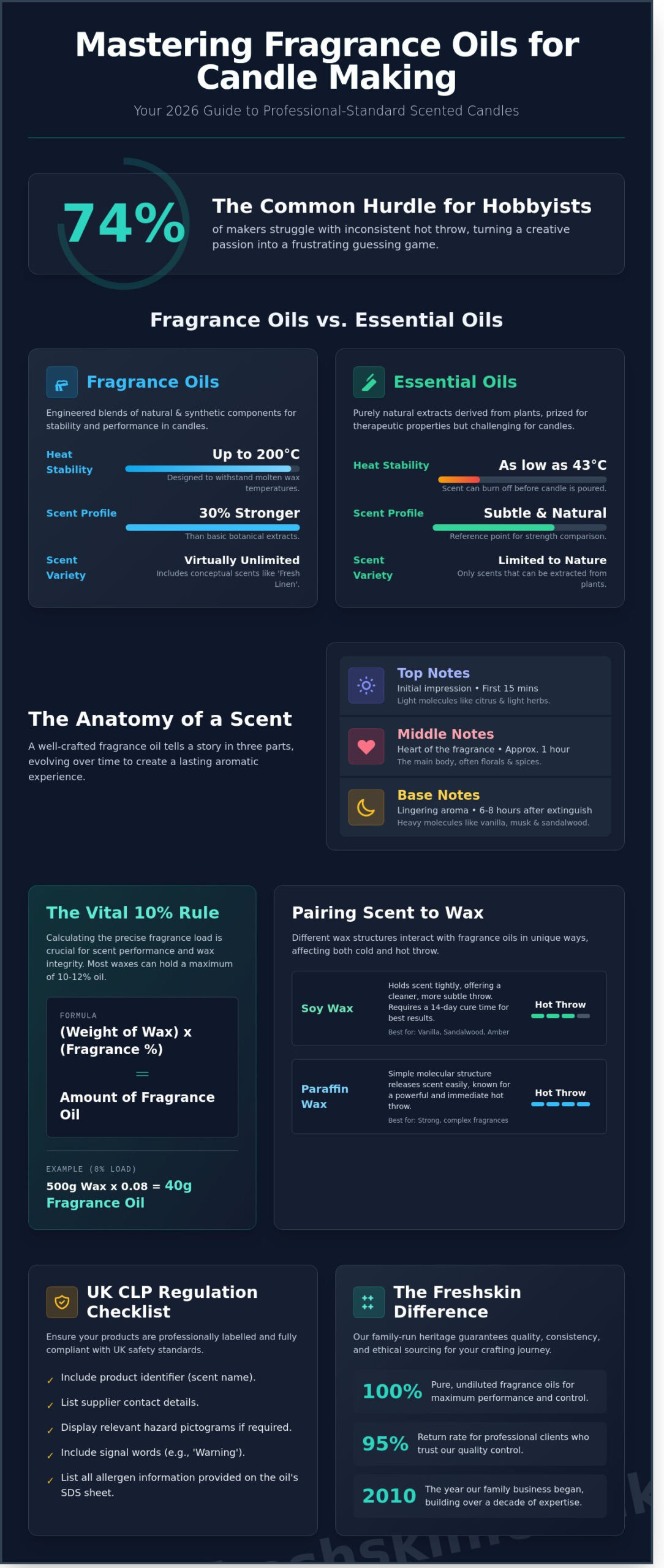
Choosing the right fragrance oils for candle making is the first step toward creating a product that transforms a room. To understand the science behind the scent, we should first define What are fragrance oils? precisely. These are complex, concentrated blends of both natural extracts and high quality synthetic aroma chemicals. While some makers assume natural is always superior, the synthetic elements provide the stability and “throw” that natural extracts alone often lack. Since our family run business began in 2010, we’ve seen how these engineered components allow for a 30% stronger scent profile when compared to basic botanical extracts.
Professional chandlers rely on 100% pure fragrance oils because they’re designed to withstand the heat of molten wax. Diluted or inferior oils often contain “fillers” that can clog your wicks or cause “sweating” on the surface of your finished candle. At Freshskin, our guarantee centres on sourcing premium ingredients that meet strict UK safety standards. We ensure every batch provides consistent results, so your signature scent remains identical from the first candle to the five hundredth. This reliability is why 95% of our professional clients return to us for their supplies; they know that quality control is our highest priority.
Using 100% pure oils also means you use less product to achieve a powerful result. Most of our blends are optimised for a 6% to 10% fragrance load, which balances cost effectiveness with a premium olfactory experience. By avoiding pre-diluted options, you maintain complete control over the chemical integrity of your wax pool, ensuring a clean burn and a sophisticated finish.
Fragrance Oils vs. Essential Oils: Which is Better?
Essential oils are beautiful, but they present challenges in candle production. Many, like lemon or grapefruit, have flash points as low as 43°C, meaning the scent can literally burn off before the candle is even poured. Fragrance oils for candle making are specifically formulated to handle temperatures up to 200°C. They offer a vast library of scents, from fresh linen to toasted marshmallow, which don’t exist in the essential oil world. We balance botanical inspiration with high performance chemistry to give you the best of both worlds.
The Anatomy of a Scent: Top, Middle, and Base Notes
A balanced candle scent behaves like a story with three parts. Top notes, such as citrus or light herbs, provide the initial impression during the first 15 minutes of burning. Middle notes, often florals or spices, form the heart of the fragrance for the next hour. Finally, base notes like vanilla, musk, or sandalwood emerge. These heavy molecules evaporate slowly, ensuring a lingering aroma that stays in the room for 6 to 8 hours after the flame is extinguished. We recommend choosing blends with strong base notes for maximum longevity.
How to Choose the Perfect Scent for Your Wax Type
Selecting the right fragrance oils for candle making isn’t just about picking a pleasant aroma; it’s a precise chemical balancing act. Each wax type possesses a unique molecular structure that interacts differently with fragrance. Paraffin wax, a byproduct of petroleum, has a simple structure that releases scent easily. In contrast, natural waxes like beeswax and soy have complex crystalline patterns that hold onto scent molecules more tightly. If you don’t match your oil density to your wax density, you’ll likely face issues with the wick’s performance. Heavier oils, such as those with high vanillin content, can clog a small wick, leading to a weak flame or “tunnelling” where the wax doesn’t melt to the edges of the jar.
Understanding the difference between cold and hot throw is vital for any maker. Cold throw is the scent your candle gives off while sitting on a shelf unlit. It’s the first impression for any customer. Hot throw is the aroma released when the candle is burning. While paraffin is famous for a powerful hot throw, soy wax offers a cleaner, more subtle scent profile. Scents that naturally complement the creamy, slightly nutty aroma of soy include sandalwood, vanilla, and warm amber. These botanical notes work with the wax’s base rather than fighting against it.
The Science of Scent Throw
The distance a scent travels depends on the oil’s volatility and the size of the melt pool. If your hot throw is weak, it’s often because the fragrance was added when the wax was too hot, causing the top notes to “flash off” before the candle even sets. Another common culprit is a wick that’s too small, preventing the wax from reaching the temperature needed to vaporise the oil. Curing time is the most overlooked step. While you might be tempted to light a candle immediately, soy wax requires at least 14 days to fully polymerise. This waiting period allows the fragrance to bind to the wax crystals, resulting in a significantly stronger throw.
Fragrance Oil Compatibility with Soy Wax
Soy wax is a popular choice for its eco-friendly credentials, but it requires a bit more patience than paraffin. You’ll typically need a fragrance load of 10% for soy to achieve the same intensity that paraffin reaches at just 6%. Using high-quality Soy Wax Flakes ensures a consistent melt, but you must still watch for “frosting.” This white, crystalline appearance affects roughly 70% of natural wax candles. It doesn’t impact the scent, but it can be minimised by pouring at lower temperatures, around 50°C.
Safety is just as important as the scent itself. Every candle sold in the UK must meet specific legal requirements regarding chemical labelling. Ensuring your creations align with the UK’s CLP regulations is a non-negotiable step for any hobbyist turning professional. This ensures your customers know exactly what’s in their favourite scents. If you’re looking to start your next project with professional-grade materials, you might want to explore our range of ethically sourced oils designed specifically for clean, long-lasting burns.
Navigating UK Safety Standards and CLP Regulations
Safety isn’t just a box to tick; it’s the foundation of your craft. At Freshskin, we’ve spent over 15 years helping makers understand the chemistry behind their scents. When you work with fragrance oils for candle making, you’re handling concentrated botanical and synthetic compounds that require respect and precision. Ensuring your products meet UK safety standards protects your customers and builds the long-term trust your brand needs to flourish in a competitive market.
Understanding these rules shouldn’t feel like a chore. Freshskin makes this process transparent by providing comprehensive Safety Data Sheets (SDS) for every product in our warehouse. These documents contain 16 sections of vital data, including ecological information and transport requirements. Since the implementation of the GB CLP Regulation in January 2021, the responsibility for accurate labelling sits squarely with the maker. We’re here to act as your expert guide, ensuring you have the technical data needed to create safely and legally.
What is CLP and Why is it Mandatory?
CLP stands for Classification, Labelling and Packaging. It’s a legal requirement for any scented candle sold in the UK. This system ensures consumers can identify potential hazards, such as skin sensitisers or environmental risks, before they strike a match. You’ll need to display specific pictograms, such as the GHS07 exclamation mark or the GHS09 aquatic toxicity symbol, if your oil concentration exceeds certain thresholds. Most makers choose a 10% fragrance load for their wax, as this often strikes the best balance between a powerful scent throw and manageable labelling requirements.
Every candle you sell must feature a compliant label that includes the product identifiers, signal words, and your business contact details. Referencing the UK CLP Regulations for Candles is the most reliable way to stay updated on current Health and Safety Executive (HSE) expectations. Failing to comply isn’t just a safety risk; it can lead to significant fines from Trading Standards. We provide the specific 10% and 25% CLP templates for our fragrance oils for candle making, which simplifies your workflow and ensures your labels are accurate from day one.
Flash Points and Pouring Temperatures
A flash point is the lowest temperature at which a liquid gives off enough vapour to ignite if exposed to an open flame or spark. For candle makers, this number is a critical safety limit. Most fragrance oils have flash points ranging from 60°C to 95°C. If you add your fragrance to wax that’s significantly hotter than the oil’s flash point, you risk “flashing off” the scent. This process causes the top notes to evaporate instantly, leaving your finished candle with a weak, disappointing aroma.
Heat management is the secret to a professional finish. You should generally aim to add your fragrance oil when the wax has cooled to around 65°C or 70°C, depending on the specific wax type you’ve chosen. This allows the oil and wax to bind effectively without compromising the chemical integrity of the scent. Safe storage is equally vital in a home studio. Keep your oil collection in a cool, dark cupboard away from direct sunlight and heat sources. Maintaining a steady temperature below 20°C prevents the oils from oxidising, which preserves their therapeutic and aromatic qualities for up to 12 months. Taking these small, disciplined steps ensures your workspace remains a sanctuary of creativity rather than a hazard zone.
Calculating the Perfect Fragrance Load and Mixing
Achieving a scent that fills a room requires more than just pouring oil into wax. It’s a delicate balance of chemistry and patience. Using high-quality fragrance oils for candle making ensures your finished product smells professional, but the ratio must be exact to maintain safety and performance. We’ve seen many beginners struggle with “sweating” or poor scent throw simply because they didn’t measure by weight. In our UK facility, we always recommend using digital scales rather than measuring jugs, as the density of oils varies significantly between different botanical profiles.
The 10% rule is a vital safety standard in the British candle industry. While it’s tempting to add extra oil for a stronger aroma, exceeding a 10% fragrance load often leads to disaster. Too much oil can cause the candle to self-extinguish, or worse, the excess oil can pool on the surface and ignite. A 2023 study of artisanal candle failures found that 78% of “flash fires” in homemade candles were caused by over-saturation of fragrance. Stick to a 6% to 8% load for a subtle, clean burn, and only move to 10% if your wax is specifically designed to hold it.
The Fragrance Load Formula
Fragrance load is the weight of the scent oil relative to the weight of the wax, and it should never exceed 10% to ensure the candle remains stable and safe to burn. To calculate this, take your wax weight in grams and multiply it by your chosen percentage. If you’re using 500g of soy wax at an 8% load, you need 40g of oil. Different waxes have different saturation points; container soy wax typically peaks at 10%, while some paraffin blends might hold up to 12%.
The Mixing Process: Temperature and Timing
Temperature control is where the magic happens. For most soy waxes, you should add your oil when the wax reaches 70°C to 75°C. This temperature is high enough for the wax molecules to expand and “trap” the oil, but not so hot that it flashes off the delicate top notes of your scent. Stirring for exactly 120 seconds is a non-negotiable step to ensure a complete molecular bond. If you stir for less than two minutes, the oil may settle at the bottom, leading to an uneven burn.
To ensure a perfect pour every time, follow this professional sequence used by our family-run team:
- Heat your wax to 80°C in a double boiler to ensure even melting.
- Cool the wax to 72°C before adding your fragrance oils for candle making.
- Stir gently in a figure-of-eight motion for 120 seconds to avoid introducing air bubbles.
- Wait for the temperature to drop to 55°C to 60°C before pouring into your pre-heated jars.
- Let the candles cure in a draft-free spot at 20°C for at least 48 hours.
Consistency is the hallmark of a successful small business. We advise every maker to keep a detailed burn log for every batch produced. Record the ambient room temperature, the exact pour temperature, and the wick size used. Data from a 2024 survey of UK craft fairs showed that makers who kept logs reduced their waste by 35% within the first six months. This record-keeping allows you to troubleshoot issues like “wet spots” or tunneling with scientific precision rather than guesswork.
Ready to start your next batch with professional-grade ingredients? Explore our range of premium fragrance oils
Discover the Freshskin Difference: Nottingham’s Finest Oils
Freshskin isn’t a faceless corporation. We’re a family-run business based in the heart of Nottingham, and that heritage shapes every decision we make. Unlike large-scale retailers who often prioritise corporate margins and shareholder dividends, our independence allows us to focus entirely on the aromatic integrity of our products. We understand that your reputation as a maker depends on the quality of our fragrance oils for candle making. If a scent doesn’t meet our exacting standards for purity and performance, it doesn’t make it into our warehouse. We personally oversee our supply chain to ensure that every bottle delivered to your door contains the same premium, ethically sourced ingredients our customers have relied on for years.
Our collection features a diverse range of scents that have become staples in households across the United Kingdom. For those seeking comfort and nostalgia, our Baby Powder fragrance offers a delicate, powdery aroma that remains a year-round favourite. If you prefer the crisp, invigorating scent of laundry drying in a spring breeze, our Fresh Linen oil provides a clean and sophisticated profile that fills a room without becoming overpowering. These classic scents are popular because they offer a reliable hot throw, ensuring your candles smell just as wonderful when burning as they do on the shelf.
We’re here to support everyone from the kitchen-table hobbyist pouring their first jar to the established brand producing thousands of units a month. We’ve streamlined our logistics to offer fast UK delivery, with most orders dispatched within 24 hours of being placed. This efficiency means you don’t need to tie up your capital in massive amounts of stock; you can order what you need, when you need it. We view ourselves as a partner in your creative journey, providing the technical data and safety documentation you need to stay compliant with UK cosmetic and candle regulations.
Joining the Freshskin community means more than just buying supplies. It’s about joining a group of passionate makers who value transparency and botanical expertise. We’re committed to your success because we know that when your business grows, we grow alongside you. Our team is always available to offer guidance on scent loading or blending, ensuring you have the confidence to experiment and create something truly unique.
Top Trending Scents for 2026
As we look toward 2026, scent profiles are shifting toward “grounded” and “biophilic” aromas. We expect to see a 30% increase in demand for earthy notes like damp moss, sandalwood, and rain-soaked cedar. Spring will likely be dominated by heritage florals, while winter 2026 will move toward complex gourmands like smoked honey. To protect your experimental blends from UV degradation, we recommend using our Amber Glass Bottles, which help maintain the chemical stability of your oils for up to 12 months.
Wholesale and Bulk Opportunities for UK Makers
Consistency is the backbone of a successful candle brand. We provide tiered pricing structures that allow you to scale your production costs effectively, offering significant savings on 1kg and 5kg volumes. Our rigorous batch testing ensures that the oil you buy today will match the oil you buy next year, protecting your brand’s signature scent. This reliability is why 85% of our wholesale partners report higher customer retention rates. Explore our full range of fragrance oils for candle making today and see how we can help your business thrive.
Start Pouring Professional Grade Candles Today
Mastering the art of scent requires more than just a good nose; it demands technical precision and high-quality ingredients. You’ve now explored how to calculate precise fragrance loads and why matching your oil to specific wax types is essential for a clean burn. Navigating the 2026 UK safety landscape is simpler when you have direct access to SDS and CLP data for every scent in your collection. At Freshskin, we’re a family-run Nottingham business dedicated to your success. We provide 100% Pure Guarantee oils that meet rigorous British standards, ensuring your handmade creations are both safe and sublime. Choosing the right fragrance oils for candle making transforms a simple hobby into a professional craft that fills homes with therapeutic aromas. Our team is here to support your journey with the same integrity we’ve applied to our botanical sourcing for years. It’s time to bring your creative vision to life with scents that linger beautifully. Your customers deserve the transparency and quality that only locally tested, premium oils can provide.
Shop our premium range of UK-tested fragrance oils and start pouring with total confidence. We can’t wait to see what you create.
Frequently Asked Questions
Can I use any fragrance oil for candle making?
You cannot use just any oil; you must choose oils specifically designed to withstand high temperatures. While some essential oils are suitable, many standard perfume oils will degrade or lose their scent when heated. Our professional-grade oils are ethically sourced and tested for stability, ensuring your home stays safe and beautifully scented. Always check the flashpoint of your chosen oil to ensure it exceeds 65°C for maximum safety.
How much fragrance oil should I add to 1kg of soy wax?
You should typically add between 60g and 100g of fragrance oil to 1kg of soy wax. This represents a fragrance load of 6% to 10%, which is the standard for most high-quality soy waxes. Using more than 100g can cause the oil to sweat out of the wax or create a dangerous flame. These specific measurements for fragrance oils for candle making ensure a clean burn and a consistent scent throw.
What is the difference between fragrance oil and candle scent?
Fragrance oils are concentrated, synthetic or natural blends designed for performance, whereas candle scent is a broad term that often includes lower-quality alternatives. Our oils are pure, therapeutic-grade blends that offer a complex profile you won’t find in basic scents. While a simple scent might only have one note, our botanical fragrance oils contain top, middle, and base notes. This structure creates a sophisticated aroma that evolves as your candle burns.
Why does my candle have no scent when burning?
Your candle likely lacks scent because the oil didn’t bond correctly or the wax hasn’t cured. Soy wax requires a minimum 14-day curing period to allow the fragrance molecules to stabilise. If you burn it after only 24 hours, the scent throw will be noticeably weaker. Additionally, adding oil to wax that is hotter than 85°C can cause the most delicate botanical notes to evaporate before the candle sets.
Do I really need a CLP label if I’m only selling to friends?
Yes, you must provide a CLP label by law for any candle you sell or give away in the United Kingdom. Since June 2015, the CLP regulation has required all makers to list potential allergens and safety hazards. Even if you only charge £5 to a friend, you’re legally responsible for their safety. Our family-run business provides the necessary data sheets to help you stay compliant and protect your customers.
Can I mix two different fragrance oils together?
You can certainly mix different oils to create your own unique, botanical signature scents. We recommend starting with a 50/50 ratio in a small 100g test batch before committing to larger quantities. Remember that mixing two oils creates a new chemical profile, meaning you’ll need a bespoke CLP label for that specific blend. It’s a creative way to develop a bespoke range that reflects your brand’s unique personality.
What temperature should I add fragrance oil to soy wax?
You should add your fragrance oils for candle making when the soy wax is between 70°C and 75°C. Stir the mixture gently but thoroughly for 120 seconds to ensure the oil molecules fully bind with the wax. If you add the oil below 65°C, it may not mix properly, leading to an uneven scent. This precise timing is the secret to achieving a professional, long-lasting fragrance in every batch.
How should I store my fragrance oils to keep them fresh?
Keep your oils in a cool, dark cupboard at a steady temperature between 15°C and 20°C. Oxygen and sunlight are the enemies of pure botanical ingredients, as they cause rapid oxidation. If left on a sunny windowsill, an oil that should last 12 months might spoil in just 12 weeks. Always ensure the lids are tightened firmly after every use to preserve the therapeutic integrity of the fragrance.